

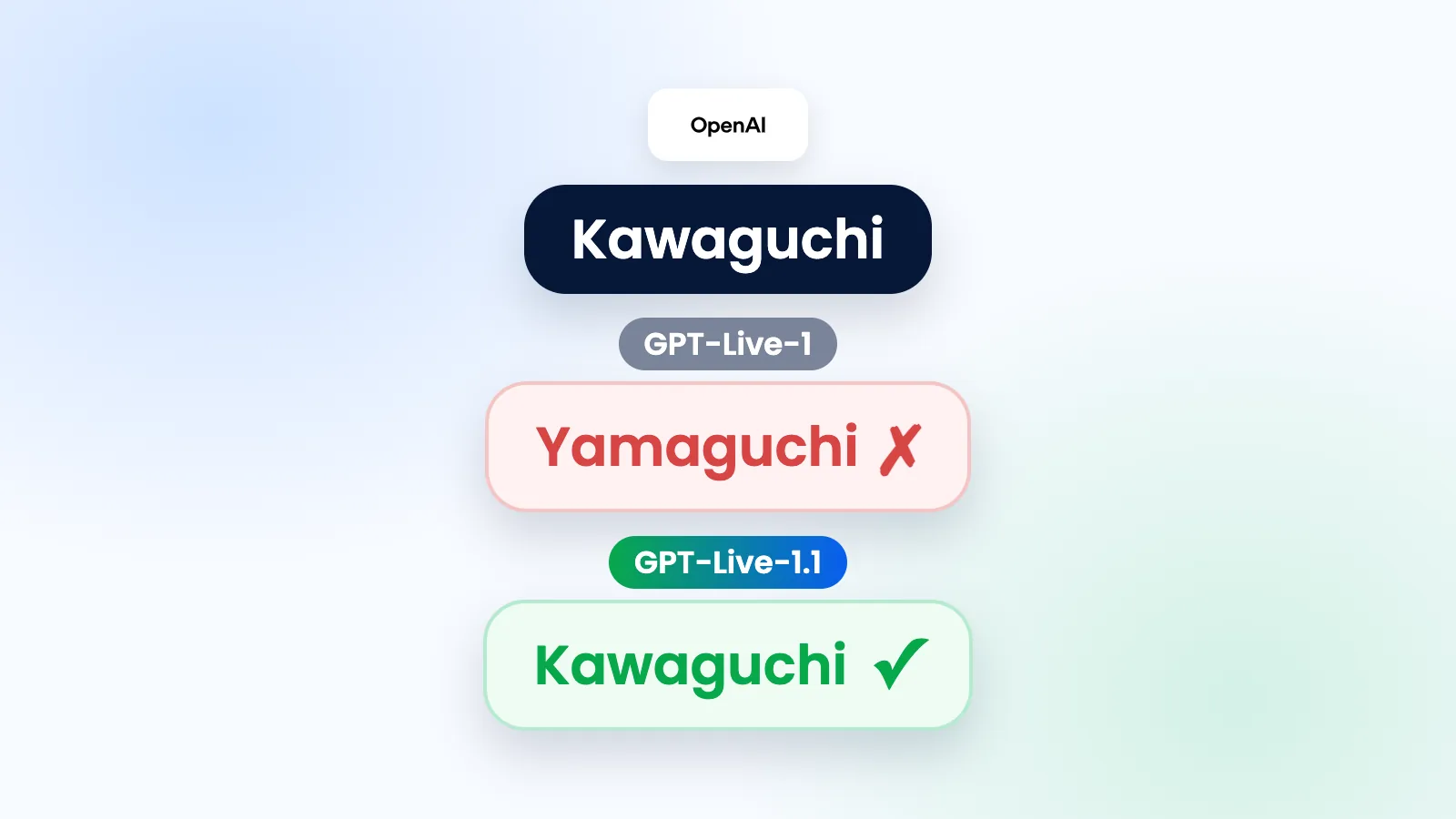
November 20, 2026, the day after the developer launch
A customer calls a restaurant, spells out their surname letter by letter, and dictates a mobile number, at the audio quality of an ordinary phone call. This is the moment where every business voice agent either works or fails.
OpenAI promised that GPT-Live-1.1, its new voice model, understands letters and numbers better. So I tested it: 120 calls, 10 languages, the new version against the old one, with the same voice and the same caller recording.
GPT-Live-1.1 got 52% of the details right. The previous version: 40%. And OpenAI's own transcription model, on the exact same recording, got almost everything.
GPT-Live-1.1 is OpenAI's voice model: a model that listens and speaks in real time, and hears you even while it's talking itself. It powers ChatGPT's voice mode, and since November 19, 2026 you can also build a voice agent with it, for example a rep who answers your business phone. OpenAI hasn't published any performance benchmarks for it, and independent benchmarking groups haven't measured it yet, so I tested it myself.
In short
- GPT-Live-1.1 is OpenAI's new voice model. It has powered ChatGPT's voice mode since October 15, and since November 19 it's also available to developers, at 5 cents per minute of conversation, the same as the previous version.
- In my test, 120 calls across 10 languages: when a caller spells a name and dictates a phone number over a phone line, GPT-Live-1.1 got 52% of the details right, versus 40% for the previous version. A real improvement, but almost half the details are still wrong, and the model almost never asked the caller to repeat.
- When the model gets the data from the system and only has to say it, both versions barely make mistakes, and there's no difference between them.
- The change with the biggest effect on the bill: Standby mode. When nobody is talking, a minute costs 2 cents instead of 5. It's one more cut in a run of OpenAI price cuts: since September, not one of its official prices has gone up.
- For a business: a voice agent can run the conversation, but details like a name and phone number need a second check, by text message or a separate transcription.
Prefer to watch? Every recording in a 6-minute video
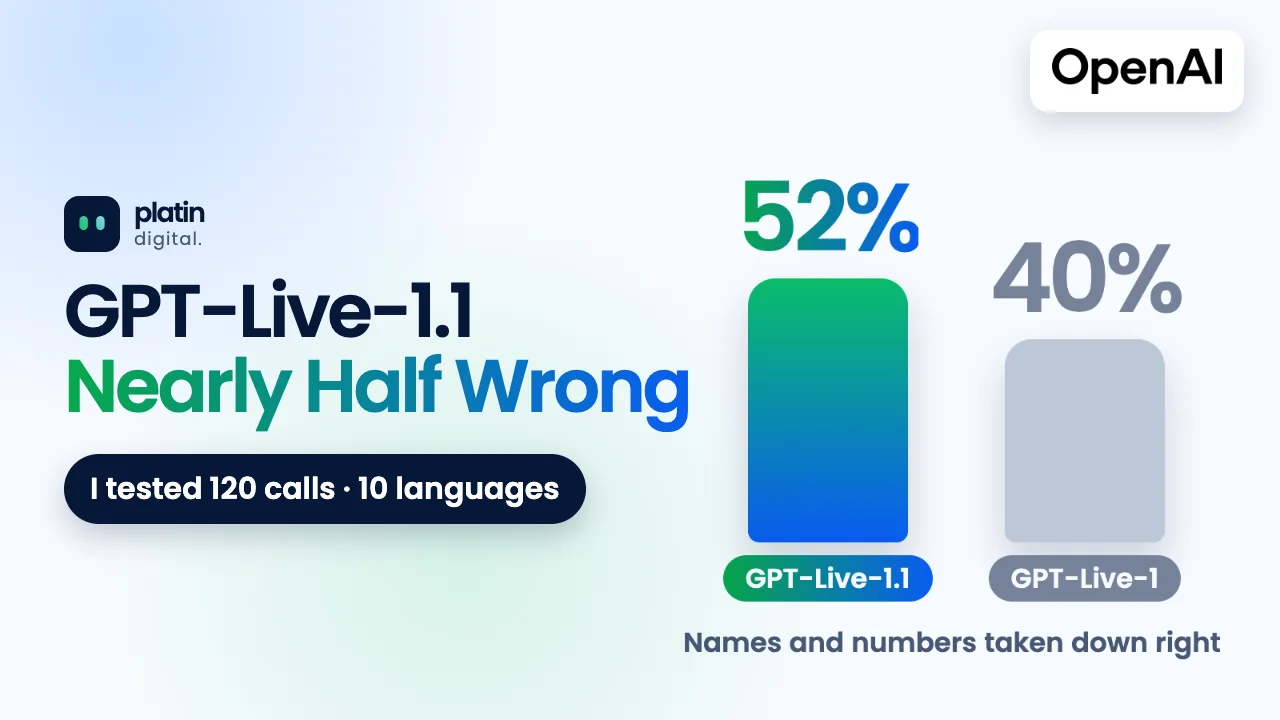
My test, at a glance
My take: it hears better, but not well enough yet
GPT-Live-1.1 is a real improvement, and you still can't trust it alone to take down details. In my test, the new version got more details right than the old one, mainly when spelling names, but it still got almost half of them wrong. And what worries me more than the mistakes: in 58 of 60 calls, the model didn't ask the caller to repeat. Even when it was wrong, it simply read back, confidently, what it thought it had heard.
Think of a receptionist at an office. She answers the phone, listens, sounds friendly, and doesn't get flustered when she's interrupted. When something needs checking in the calendar or a quote needs working out, she passes a note to the manager in the back office and keeps chatting with the customer until the answer comes back. That's how GPT-Live is built: the voice model is the receptionist, and it hands the thinking, the searching and the actions in your systems to a "backend model" you choose. OpenAI calls this delegation.
This receptionist is pleasant and fluent, but she writes the phone number down wrong about every other call, and doesn't ask to hear it again. The fix is not to leave her alone with the details: send the customer the details by text message to confirm, or run the recording through a separate transcription and compare.
My test: 120 calls in 10 languages
I tested both versions in ten languages: the six languages this site is published in (Hebrew, English, Arabic, Russian, Spanish and Portuguese), plus four that OpenAI highlighted at launch (French, German, Hindi and Japanese). In each language, two tests, with three runs per test and per version:
- Speaking test. The model gets booking data from the system and confirms it to the customer out loud, in its own words: a first name, 6 guests, Thursday, March 12, 19:45, an exact price in the local currency, and the restaurant's phone number. Six details per call.
- Listening test. A caller spells a surname letter by letter and dictates a mobile number, over a line at phone-call quality, and the model has to repeat both back. Two details per call. The caller is a synthetic Google voice, so that neither version gets the advantage of an OpenAI voice, and it's identical for both.
Every recording was checked against the data using two transcripts: what the model itself logged as having said, and an independent transcription of the audio. A detail counted as correct only when both agreed it was correct.
Listening over a phone line: share of details captured correctly
Speaking from system data: share of details said correctly
Listening: 31 vs. 24 correct details out of 60. Speaking: 148 vs. 149 out of 180.
Listening, by language: each filled dot is a detail captured correctly (out of 6)
| Language | GPT-Live-1 | GPT-Live-1.1 | Change |
|---|---|---|---|
| Arabic | 2/6 | 5/6 | 1.1 better |
| Japanese | 1/6 | 4/6 | 1.1 better |
| English | 3/6 | 5/6 | 1.1 better |
| Spanish | 2/6 | 4/6 | 1.1 better |
| Russian | 0/6 | 1/6 | About the same |
| Portuguese | 1/6 | 1/6 | About the same |
| German | 5/6 | 5/6 | About the same |
| Hindi | 3/6 | 3/6 | About the same |
| Hebrew | 2/6 | 1/6 | About the same |
| French | 5/6 | 2/6 | 1.1 worse |
Platin Digital test, November 20, 2026, via the OpenAI API (gpt-live-1 and gpt-live-1.1, Marin voice, no backend model). 3 runs per language, test and version. A detail the transcripts disagreed on counted as not correct. With 3 runs, a one-detail difference in a language is noise. Total cost of the whole test: $4.30.
Listen for yourself: one run from each language
Booking confirmation. It should say: Siobhan · 6 · Thursday 12/03 · 19:45 · £347.50 incl. deposit · 0161 482 0957
GPT-Live-1
GPT-Live-1.1
Read 12/03 as December 3
Phone-line call. The caller spells and dictates: Kowalczyk · 07700 900461
GPT-Live-1
The transcripts disagree: it may have dropped the L and one digit
GPT-Live-1.1
Booking confirmation. It should say: מיכל · 6 · יום חמישי 12/03 · 19:45 · 347.50 ₪ כולל מקדמה · 052-748-1093
GPT-Live-1
GPT-Live-1.1
Phone-line call. The caller spells and dictates: ברקוביץ' · 054-638-2097
GPT-Live-1
Spelled it ב-ר-ש-ק-ו-י-צ: added a ש (sh) and dropped a ב (b)
GPT-Live-1.1
Spelled it with ש, פ and ו, letters the caller never said
Booking confirmation. It should say: ريم · 6 · الخميس 12/03 · 19:45 · 347.50 ريال شامل العربون · 011 482 0957
GPT-Live-1
GPT-Live-1.1
Phone-line call. The caller spells and dictates: القحطاني · 055 734 1906
GPT-Live-1
Dropped digits from the phone number
GPT-Live-1.1
Said 0741906 instead of 0557341906
Booking confirmation. It should say: Ольга · 6 · четверг 12.03 · 19:45 · 18 347,50 ₽ с депозитом · +7 495 482-09-57
GPT-Live-1
GPT-Live-1.1
Phone-line call. The caller spells and dictates: Шевчук · +7 916 482-31-57
GPT-Live-1
Spelled only three letters, and added digits to the phone number
GPT-Live-1.1
Added a letter, swapped one and dropped the last
Booking confirmation. It should say: Lucía · 6 · jueves 12/03 · 19:45 · 347,50 € con la señal incluida · 915 48 20 95
GPT-Live-1
GPT-Live-1.1
Phone-line call. The caller spells and dictates: Echeverría · 612 48 30 95
GPT-Live-1
Didn't spell the name back
GPT-Live-1.1
Booking confirmation. It should say: Mariana · 6 · quinta-feira 12/03 · 19:45 · R$ 347,50 com o sinal incluído · (11) 3482-0957
GPT-Live-1
GPT-Live-1.1
Phone-line call. The caller spells and dictates: Gonçalves · (11) 98473-2065
GPT-Live-1
Dropped the N and the S from the name
GPT-Live-1.1
Dropped the Ç, invented a first name, and dropped 11 9 from the phone number
Booking confirmation. It should say: Camille · 6 · jeudi 12/03 · 19h45 · 347,50 € acompte compris · 01 48 20 95 73
GPT-Live-1
GPT-Live-1.1
Phone-line call. The caller spells and dictates: Lefebvre · 06 47 38 21 95
GPT-Live-1
GPT-Live-1.1
Dropped the L and R from the name, and 06 47 from the phone number
Booking confirmation. It should say: Anna · 6 · Donnerstag, 12.03. · 19:45 Uhr · 347,50 € inkl. Anzahlung · 030 4820957
GPT-Live-1
GPT-Live-1.1
Phone-line call. The caller spells and dictates: Schwarzkopf · 0171 4839205
GPT-Live-1
The transcripts disagree on the last letter of the name
GPT-Live-1.1
Booking confirmation. It should say: प्रिया · 6 · गुरुवार 12/03 · 19:45 · ₹3,475.50 एडवांस सहित · 022 4820 9573
GPT-Live-1
GPT-Live-1.1
Phone-line call. The caller spells and dictates: Bhattacharya · 98201 47365
GPT-Live-1
Spelled BHATTARA, without the CHARY
GPT-Live-1.1
Cut the caller off, dropped the final A and most of the phone number
Booking confirmation. It should say: さくら · 6 · 3月12日(木) · 19:45 · 34,750円(予約金込み) · 03-4820-9573
GPT-Live-1
GPT-Live-1.1
Phone-line call. The caller spells and dictates: カワグチ · 090-4827-3615
GPT-Live-1
Heard ヤマグチ instead of カワグチ, and got the phone number wrong
GPT-Live-1.1
The recordings are the first run in each language, not hand-picked. ✓ correct, ✗ wrong, ? the transcripts disagreed, worth a listen. In the phone-line call you hear both sides, at the quality the model heard the caller.
What the results show:
- In speaking, there's no difference. Almost everything that didn't count as correct was a case where the independent transcription heard something else, not a clear model error. Definite errors were rare: once, GPT-Live-1.1 read "12/03" in English as December 3, and GPT-Live-1 skipped the restaurant's phone number three times. In German, both versions addressed the customer as du, the informal "you", in every call. In Japanese, GPT-Live-1.1 slipped into a casual register that doesn't suit a restaurant in two of its three calls.
- In listening, the improvement is in spelling, not in numbers. GPT-Live-1.1 spelled 15 of 30 names correctly, versus 9 for the previous version. On phone numbers there's almost no difference: 16 vs. 15 out of 30. The hardest name was the Hebrew "Berkovich" (ברקוביץ'): neither version spelled it correctly in any of the six calls.
- The differences between languages are a direction, not proof. With three runs per language, one detail moves the result. The notable gaps: Arabic and Japanese in favor of 1.1, French in favor of the previous version. In Russian and Portuguese, both versions failed almost every time.
- They talk over the caller. In 42 of 60 calls, the model started speaking before the caller had finished, usually when the caller paused for a moment mid-spelling. In French it happened in all six calls.
And the control test: I ran the same caller recording, at the same phone quality, through OpenAI's transcription model, gpt-4o-transcribe. It got all ten phone numbers and 9 of the 10 spellings right. In other words, the audio is clear, and the errors belong to the conversation models.
Caveats: the caller in the recording is a clear synthetic voice, and a real caller with background noise and an accent will probably make things harder. And I tested one voice and one prompt, with no backend model.
GPT-Live-1.1 in a minute
Sources: OpenAI's model page, pricing page, changelog and developer guides, and the model's system card, November 20, 2026. What tokens are: What is a token.
According to OpenAI, compared with GPT-Live-1 the new version "transcribes speech more accurately and maintains a more consistent accent and voice across languages." The announcement on X added two more claims: that it can "reliably understand precise details like letters and numbers," and that it "completes tasks even more reliably." If you've already built on the previous version, switching means changing the model name in your settings, with no code changes.
- The voice model doesn't call tools itself. Web search, files, MCP connections and actions in your systems all go to the backend model. According to the system card, it passes the user's request along as is, without summarizing it. More on connections like these: What is MCP.
- European data residency and phone-line connections: the data residency table and the phone connection examples currently list only GPT-Live-1. The new version is probably supported, but that isn't documented yet.
Standby mode: OpenAI keeps cutting prices
The most practical change in this launch isn't the voice. It's what happens when nobody is talking. Until now, every minute the call was open cost 5 cents, whether the customer had gone to look for a document or the agent was just sitting there on screen. Standby mode changes that: after 5 to 60 seconds of silence, whichever you set, the model stops working, the line stays open, and a minute costs 2 cents until someone speaks again.
A voice assistant open 8 hours a day that actually talks for one hour (illustration)
Platin Digital calculation based on GPT-Live-1.1 prices on OpenAI's pricing page, November 20, 2026. The usage figures are invented, for illustration. Backend model not included.
Where it helps: a voice assistant on a website or in an app, a kiosk in a store, or a screen in an office that people talk to throughout the day. Three caveats:
- Browser connections (WebRTC) only. According to the documentation today, a call over a phone line doesn't get the discount.
- Muting isn't Standby. As one developer pointed out on X, a muted microphone and time spent waiting for an answer from the backend model count as active time, at 5 cents a minute. It's not yet clear whether Standby kicks in during hold music. Developers have asked, and OpenAI hasn't answered yet.
- Waking up takes a moment. According to OpenAI, the first reply after Standby can be delayed.
Standby also works on GPT-Live-1, and the new version costs the same as the old one. So for the same money you get an improved model, and you pay 60% less for silence. That's no accident; it's been OpenAI's pattern for the past few months:
OpenAI since September: every launch cut the price or held it
- GPT-6 Sol and GPT-6 Luna: −50%Both models' prices were cut in half
- GPT-6.1 Sol: same priceAnd repeated (cached) input costs half as much
- GPT-6.1 Terra: half the price of SolA new, cheaper model for simple work
- GPT-6.2 Astra: −20%Sol stayed at the same price
- GPT-Live-1.1: same price, and silence 60% cheaperStandby mode: 2 cents a minute instead of 5
Sources: OpenAI's developer pricing page and changelog, and the launch pages, 2026. Since GPT-6 Astra in early September, not one official OpenAI price has gone up.
For a business, this means a voice agent that didn't pay off six months ago may pay off today, and that it's worth redoing the math with every launch. On the same trend in the text models: my review of GPT-6.2 Astra and Sol.
What a minute of conversation really costs
5 cents a minute comes to about $3 per hour of talking. But that's the price of the voice alone. Every time the agent checks the calendar, calculates something or searches, the backend model is billed by the token, like any other text model.
Cost of running the Artificial Analysis benchmark (on GPT-Live-1, the previous version)
Source: Artificial Analysis, cost of running the benchmark per hour of input audio, October 29, 2026. The name after GPT-Live-1 is the backend model it was measured with.
In a separate test by Icana, a company that sells tools for call centers, the previous version (GPT-Live-1 with an OpenAI backend model) cost $31 per 100 simulated calls, versus $9 for Gemini 3.8 Live.
The math for a business: a call center that takes 300 calls a month, 3 minutes each, would pay about $45 a month for the voice (900 minutes times 5 cents). That's an illustration, not a quote: on top of it come the backend model, the telephony provider and the setup. What an agent like this actually costs, setup included, is explained in my guide How much does an AI agent cost.
Against Grok, Gemini and Phonic: what the benchmarks say
Which brings me back to the caveat from the start: GPT-Live-1.1 isn't on any independent leaderboard yet. Every number here was measured on GPT-Live-1.
Artificial Analysis voice conversation index (out of 100, higher is better)
How long until it starts speaking (shorter is better)
Source: Artificial Analysis, Speech-to-Speech Index and time to first audio, read on November 20, 2026. GPT-Live-1.1 isn't listed yet. On reasoning from speech (Big Bench Audio), GPT-Live-1 scored 90.1%, the lowest of all, versus 95.8%–98.9% for the rest.
GPT-Live-1 is third on the overall index, with the lowest score in the table on reasoning from speech, and it's one of the slowest there. But when the test is a long customer service conversation where a task has to be carried through to the end, it climbs to second place and overtakes Grok:
Tau Voice: share of customer service tasks completed in a voice conversation
Source: Artificial Analysis on X, October 29, 2026. Note the gap between the two GPT-Live-1 rows: the only difference between them is the backend model.
The last row is the practical lesson of the table. The same voice model, with a weaker backend model, drops from 74.5% to 59.3%. The receptionist is only as good as the manager behind her.
What other people's tests found
There are two kinds of outside evidence: small tests of the new version in the ChatGPT app, and studies of the previous version in phone calls. They line up with what I found, including the miss on reading back a phone number.
Won
- Calculating a price in a phone booking: right on the first try, 3 out of 3 times. ElevenLabs: once (version 1.1, Japanese)
- Transcription accuracy: 1.47% word error rate, versus 4.9%–6% for two other types of systems (probably version 1, Spanish)
- An "okay" mid-sentence: never logged as agreement to a deal. With the other systems, it happened (probably version 1)
Tie
- A change mid-call ("actually, make it Thursday"): both 3 out of 3 (version 1.1)
- How natural the voice sounds: almost no difference according to the testers, and ElevenLabs fits the pace of a phone reception desk slightly better (version 1.1)
- Switching from another provider: a developer who moved an existing agent to GPT-Live worked for 4 days and got a result "on par with the cascade version" he had before (version 1)
Lost
- Reading back a phone number: right 2 out of 3. Once it dropped a zero. ElevenLabs: 3 out of 3 (version 1.1)
- Speed: Icana measured 2.1–2.6 seconds per reply, "the slowest AI Voice Agent we've tested so far" (version 1)
- When Pro mode was selected: 20–40 seconds to a reply, and one failure out of three (version 1.1, ChatGPT)
Sources: the Japanese YouTube channel 仕事に活かすAI実務検証室, comparing ChatGPT and ElevenLabs on the same phone booking, October 21, 2026; arXiv paper 2611.19118, phone negotiation in Spanish, 77 calls per system; Icana Bench, November 18, 2026; a developer's report on X, November 9, 2026.
The Spanish study also documented a different kind of failure: in one of the calls, GPT-Live offered a price above the ceiling, after its own pricing tool had already rejected it.
The problem everyone who has built with it knows
On OpenAI's developer forum there's a thread whose title says it all: the voice model "sometimes never delegates (acknowledges verbally, sends nothing)." The caller says "hang up," the agent answers "Sure, I'll end this call now," and no action is sent. One team reported that in simulated tests, for 13 of 14 action requests, the model confirmed out loud and didn't act. OpenAI support wrote there explicitly that "a spoken acknowledgment doesn't confirm backend work started."
That was written about GPT-Live-1. The research lead for GPT-Live at OpenAI wrote on launch night that version 1.1 brings "improvements across the board, especially in task completion and instruction following," and recommended pairing it with GPT-6.2 Sol at low or medium reasoning. That's OpenAI's claim. Until there are measurements, I build as if the problem still exists: every "I've taken care of that" from the agent gets checked against the system, not against the sentence it said.
Developers also reported, on the previous version, a voice that switches to a male voice mid-call after a hold, and garbled call openings over phone connections. ChatGPT users are posting quite a few complaints that GPT-Live-1.1's voice sounds "like it's reading a script," along with protests over OpenAI retiring the previous voice modes on December 11.
Which languages is it good in?
OpenAI hasn't published a list of supported languages. The 21 ready-made voices in the API are in English, Portuguese, German, French, Hindi, Japanese and Korean, and at the ChatGPT launch it highlighted improvements in French, German, Hindi, Mexican Spanish, Korean and Japanese.
Being highlighted doesn't guarantee results. In French, one of the highlighted languages, GPT-Live-1.1 caught fewer details in my test than the previous version, and in replies to the launch one user wrote that "German is still making my ears bleed." In Arabic, on the other hand, the new version was more consistent in its dialect, while the old one jumped between dialects.
So, in every language, before a voice agent answers customers, run your business's real conversations through it: names, a phone number dictated out loud, a price with tax, and a sentence that mixes in an English term. If that doesn't work, the agent can work in text, on WhatsApp or Telegram, where it can also listen to voice messages.
Who it suits today, and who should wait
Not yet
Test it yourself first
- Taking down names and phone numbers by voice, with no written confirmation
- A call center that answers in a language other than English, without testing the model on real calls
- Calls where a second and a half of silence feels like the line went dead
- A process where a spoken confirmation is the end of the job, with no check in the system
Yes, right now
With a written check behind it
- A call that ends with a message containing the details for the customer to confirm
- Bookings and scheduling, when every action is checked in the calendar or the system
- Anyone who already built with GPT-Live-1: switching is a model-name change, at the same price
In my view, the common mistake will be starting with the voice. Voice is the interface, not the brain. A business that doesn't yet have an agent that can answer correctly in writing, check the calendar and prepare a quote won't gain anything from that same agent talking. Start with the tasks, in text, and once they work, add voice. More on this in What an AI agent does in a business and in my guide to AI customer service.
And if you have a ChatGPT Plus subscription or higher: GPT-Live-1.1 is the voice you've been hearing since mid-October. The fastest way to test it in your language is to open voice mode and dictate a phone number to it.
Frequently asked questions
What is GPT-Live-1.1?
OpenAI's voice model, which listens and speaks in real time. It has powered ChatGPT's voice mode since October 15, 2026, and since November 19, 2026 it's also available to developers through the API. It hands the thinking and the actions in your systems to a text model the developer chooses.
How much does GPT-Live-1.1 cost?
5 cents per minute of active conversation and 2 cents per minute in Standby, billed by the second. That's the same price as GPT-Live-1. The backend model and the telephony provider are billed separately, so the real cost per call is higher than the per-minute price.
What languages does GPT-Live-1.1 speak?
OpenAI hasn't published a list of languages. It has ready-made voices in English, Portuguese, German, French, Hindi, Japanese and Korean, and it speaks other languages too. In my test, in all ten languages I tested, both versions made mistakes taking down names and numbers, so before using it with customers, test it in their language.
What's the difference between GPT-Live-1.1 and GPT-Live-1.1 Quip?
Quip is a smaller version. In ChatGPT, GPT-Live-1.1 is the voice for Plus subscribers and up, and Quip is the voice for everyone else. In the API, OpenAI launched only gpt-live-1.1 on November 19.
Is GPT-Live-1.1 better than GPT-Live-1?
In my test, yes, but only at listening. When a caller spelled a name and dictated a phone number at phone-call quality, GPT-Live-1.1 got 52% of the details right and GPT-Live-1 got 40%, across 120 calls in 10 languages. Most of the improvement is in spelling names. When the model only had to say data it got from the system, there was no difference.
Is GPT-Live-1.1 better than Grok Voice and Gemini Live?
There's no independent measurement of the new version yet. In measurements of the previous version, GPT-Live-1 completed customer service tasks better than Grok Voice 3.0 and Gemini 3.8 Live (and worse than Phonic-1), but it was slower, and got a lower overall score than Grok and Phonic-1. When response speed matters most, Grok and Phonic lead. On task completion, GPT-Live-1 beat Grok and Gemini only with a strong backend model (Astra). With Sol at low reasoning, it fell below both.
Can I connect GPT-Live-1.1 to my business phone line?
Yes, through a direct SIP connection or through providers like Twilio and LiveKit, for inbound and outbound calls. In OpenAI's documentation, the phone connection examples are still written for version 1, but it's the same interface. In practice, you need to build the connection to your calendar and systems around it, plus the check that every action was really carried out.
Sources
- https://developers.openai.com/api/docs/models/gpt-live-1.1
- https://developers.openai.com/api/docs/models/gpt-live-1
- https://developers.openai.com/api/docs/changelog
- https://developers.openai.com/api/docs/pricing
- https://developers.openai.com/api/docs/guides/live
- https://developers.openai.com/api/docs/guides/data-residency
- https://developers.openai.com/api/docs/supported-countries
- https://deploymentsafety.openai.com/gpt-live-1-1
- https://learn.chatgpt.com/docs/pricing
- https://x.com/OpenAIDevs/status/2123506733524136446
- https://x.com/OpenAIDevs/status/2123506763144245744
- https://x.com/OpenAIDevs/status/2123506775077077489
- https://x.com/kundan2510/status/2123540549961683159
- https://artificialanalysis.ai/speech-to-speech
- https://x.com/ArtificialAnlys/status/2115836132416192848
- https://x.com/ArtificialAnlys/status/2115836139479372017
- https://x.com/evaneekelen/status/2123168636810768833
- https://x.com/evaneekelen/status/2123168643966205953
- https://x.com/icana_ai/status/2122414653620007355
- https://arxiv.org/abs/2611.19118
- https://www.youtube.com/watch?v=62NRv1WxFjA
- https://www.youtube.com/watch?v=KbsZvkzMLVI
- https://community.openai.com/t/1398585
- https://community.openai.com/t/1402189
- https://community.openai.com/t/1406704
- https://community.openai.com/t/1416086
- https://x.com/M4R10i/status/2123518168073203924
- https://x.com/Hazem_Hegazy1/status/2118633856320303532
- https://x.com/AlphaMFPEFM/status/2123531837515436249
- https://x.com/cclainstone/status/2122032313613603156
- https://x.com/Yashcsp22/status/2119830939069297081
- https://x.com/DailyXplorer/status/2123519423436976335
- https://x.com/essenaoeomeeks/status/2123512809312895200
- https://x.com/ADHDwithAI/status/2121860078437290029
- https://www.youtube.com/watch?v=fX336XCRGs8