

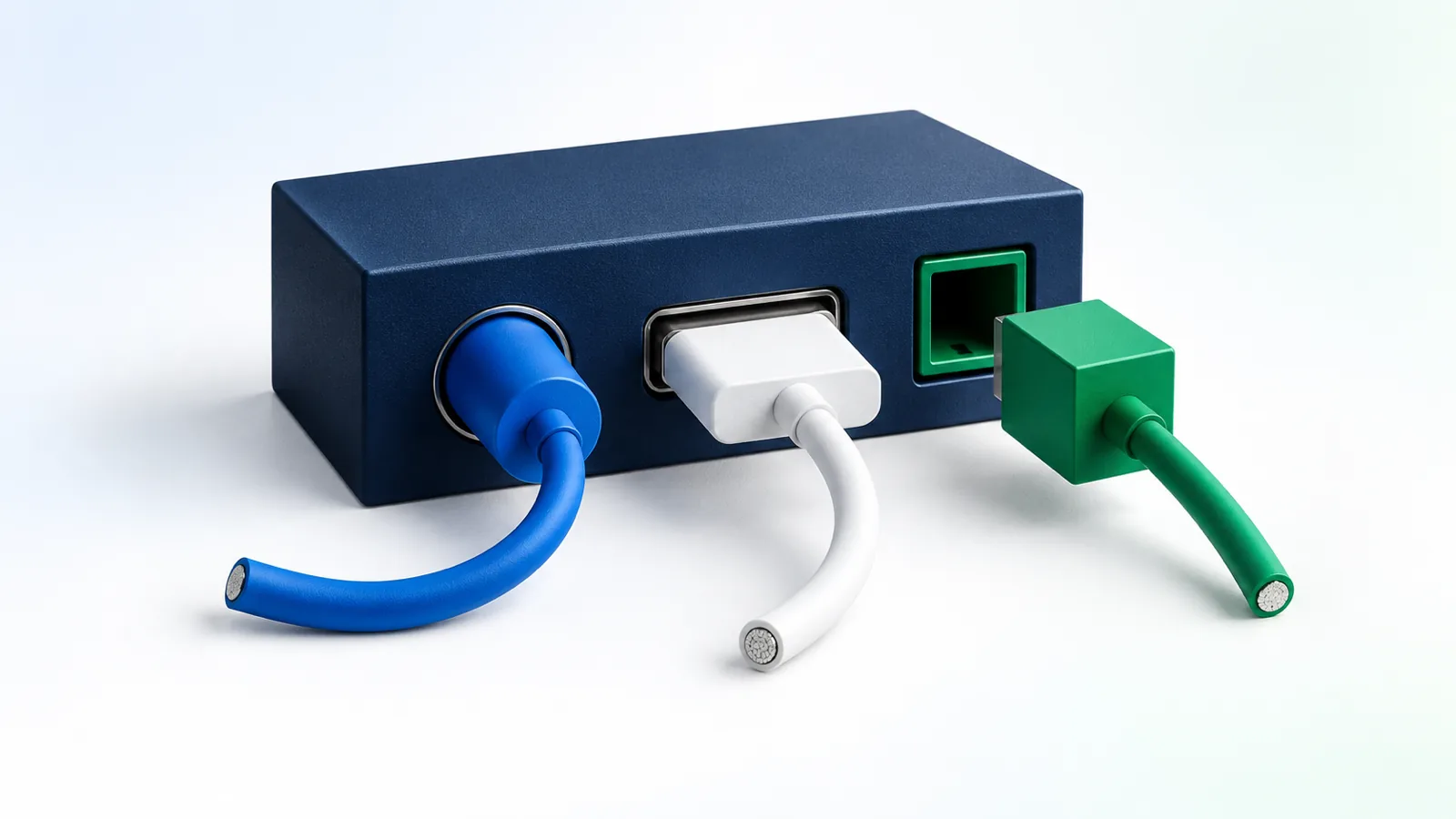
MCP (Model Context Protocol) is an open-source, open standard that defines one common way to connect artificial intelligence applications to external systems: files, databases, search tools and more.
In short
- MCP is a "shared language" in which an AI application and an external system talk to each other.
- According to the project's official website, MCP is like a USB-C port for AI applications.
- It is supported in Claude, ChatGPT, Visual Studio Code and Cursor, among others.
- MCP connects. The permissions, and the decisions about what an agent may do, are set during setup, not by the standard.
What is MCP, in one image
There was a time when every device had its own charger. Today a single USB-C cable fits a phone, a laptop and headphones. The project's maintainers use this image themselves: MCP is the "USB-C of AI applications".
Without a standard like this, every connection between an agent and a system is built from scratch, again and again. With MCP, a system that speaks this language can connect to any AI application that understands it.
How does MCP work?
The official documentation names three roles: the host, the AI application itself; the client, a component inside it that holds one connection; and the server, a program that provides context and tools. The application creates a separate client for every server connected to it.
Each server can offer three kinds of things, called primitives:
- Tools: actions the application can run, such as a database query or an API call.
- Resources: sources of information that provide context, such as the contents of a file.
- Prompts: instruction templates that organize the work with the model.
The documentation also notes that the application can ask the user for more information or for approval of an action (elicitation), and that MCP focuses only on exchanging context: it doesn't dictate how the application uses a model. The AI agent itself is explained in the article What is an AI agent.
Why does this matter for a business?
A business doesn't need to know the protocol, but it's worth understanding what it makes possible:
- Connection to existing tools. An agent can reach a business's calendar, documents or data system, if a server exists for it and you have granted permission. The official documentation mentions, for example, connecting to Google Calendar and Notion.
- Less dependence on a single application. An open standard supported by several AI applications gives you more options later, though every move still needs testing.
- Control over the limits. You connect only the servers you need, each with the minimum permission.
- One interface for different tasks. The same agent can work across several systems, without inventing a new connection for each.
When an agent is connected to tools, it's also important to know how to protect it from outside content: What is Prompt Injection.
Where MCP is less suitable
Not every connection has to go through MCP. If one system needs one action, a simple direct connection may be enough. And the common mistake in the opposite direction is to connect "everything, just in case". We connect one system at a time, only what the task needs, each with a separate permission and without your personal password.
Common myths
Myth"MCP is a product you buy or install"
In practiceMCP is a protocol, meaning a set of rules. The project includes a specification, software development kits (SDKs) and development tools, while specific servers are built by each vendor separately.
Myth"MCP only works with Claude"
In practiceThe official website lists support in Claude and ChatGPT, and in development tools such as Visual Studio Code and Cursor.
Myth"If there's MCP, the agent is safe"
In practiceThe standard defines how to talk, not what is allowed. Safety depends on the permissions of each system and on defining what needs approval. See also Prompt Injection.
Myth"MCP is only for technical people"
In practiceBuilding it is technical, but what you get is that you ask for something in conversation and the agent reaches the right system.
Related terms
- What is an AI agent: the one who uses these connections.
- What is an LLM: the model that decides which tool to use.
- What is RAG: another way to bring business information to the model.
- What is Computer Use: when there's no direct connection, the agent can operate a computer.
- AI agent for business guide: the full picture.
Frequently asked questions
What is MCP?
MCP, or Model Context Protocol, is an open-source open standard for connecting artificial intelligence applications to external systems, such as data sources, tools and workflows. It lets applications like Claude or ChatGPT reach information and perform tasks through one common connection.
What is the difference between MCP and an API?
An API is the interface of a particular system. MCP is a common standard for how an AI application discovers and runs tools. According to the documentation, MCP tools can perform API calls, file operations and database queries, among other things.
Is MCP safe?
It is neither safe nor unsafe in itself. It is a communication standard. Safety is determined by the permissions you grant, what was connected, and which actions require your approval.
Do you need MCP to run an AI agent in a business?
Not necessarily. There are several ways to connect an agent to tools, and MCP is one of them. The choice depends on the systems you have and what they support.


