
November 18, 2026, 11:00 PM Israel time
That same day, Anthropic prices the biggest IPO in history: $83 a share, raising $81.3 billion. That night, Google launches Gemini 4 Neon. It's the fourth model in the Gemini 4 family in 37 days, and the third in eight days.
Seven weeks earlier, Google had announced Argon, the first model in the family. Once it opened to everyone, it took heavy criticism for the code it wrote. Theo, one of the best-known developers on X, called it "outright unusable for real code work in my codebases."
This time Google didn't take first place. It took something worth more to a business.
Gemini 4 Neon is Google's new middle model, released on November 18, 2026. It sits between Hydrogen, the cheap everyday model, and Carbon, Google's most powerful model. We took the independent measurements published on launch night by five different organizations, plus the comparisons developers posted on X, where the same task was given to several models, and checked what this model offers a business that runs an agent.
Two terms will keep coming up. A token is a small unit of text, roughly part of a word. It's how you pay for a model, both for what it reads and for what it writes. The thinking level is a "dial" that sets how much the model thinks before it answers. Neon has four: Low, Medium, High and Xhigh. More thinking usually means more quality, and costs more money and time. Every number in this article says which level it was measured at.
In short
- At Artificial Analysis, an independent benchmarking organization, Gemini 4 Neon at its default level gets the same score as Claude Opus 5.5 at maximum thinking, for 37% of the cost per task. It ranks in the top three on the overall Artificial Analysis index, on Vals, on Agent Arena and on Mercor.
- When it doesn't know an answer, it makes one up 14% of the time, against 50% to 59% for the top models from Anthropic and OpenAI. For an agent that answers customers, that's the most important number in this article.
- It isn't the smartest model in the world: Claude Fable 5.2 and GPT-6.2 Astra are above it. And GPT-6.2 Sol does similar work for less than a third of the price. In the comparisons developers posted, no model wins every time.
- Its weakness is response time: at the default level, 40 seconds to the first word. For background work that doesn't matter. For live chat you need to lower the thinking level, and even at Low you wait about 14 seconds.
Prefer to watch? All the comparisons in a 7-minute video
My take, at a glance
My take: Google is back, and this time not just on the leaderboards
Gemini 4 Neon isn't much smarter than Carbon. It does the same work in less than half the time, and it cuts the price of Claude-level work. And Google's last three models, Carbon, Hydrogen and Neon, really are a step change for the company. Not because Google reached first place, but because it improved exactly where Argon was criticized.
It's worth remembering how this started. Argon was announced at the end of September and opened to everyone in October, with good scores. Artificial Analysis even wrote on announcement day that "Google is back" among the top three labs. But prominent developers who used it on real code were disappointed. Bloomberg reported that, according to Google's own employees, the model "does less well when employees actually put it to work," and Theo wrote that people should avoid it. Google replied that it would be "inaccurate" to say the model was underperforming at coding. On the leaderboards Argon looked good; in real work, less so.
Now look at what has moved since then, and what hasn't:
| Metric | Argon, October | Neon, today |
|---|---|---|
| Artificial Analysis overall index: gap to first place | 5 points | 4 points |
| Agent Arena, agents in real use | About 8th | 2nd |
| WebDev Arena, website building: gap to first place | 141 points | 55 points |
| Artificial Analysis coding agent index | No measurement for Argon. Carbon, late October: 3 points behind Claude | Tied with Fable 5.2 and Opus 5.5, at about half the cost |
On the overall index, Google is exactly where it was. All the change happened in the actual work: agents, websites and code, the three areas where Argon was criticized. Arena, the platform that ranks models by user votes, wrote on launch night that Google is shipping "exponentially faster": the time between launches has roughly halved each time. And even Theo, who hasn't tested Neon yet, wrote that it "looks significantly more compelling than Carbon."
The way I think of it: Neon is a senior employee on a mid-level salary. It delivers the work of the expensive experts for less than half the pay, and in testing it almost never makes things up. It has one annoying habit: before it picks up the phone, it thinks for almost a minute. For some jobs that doesn't matter at all. For others it's a dealbreaker.
And what about the Anthropic IPO? The facts: Anthropic priced its IPO on November 18, the same day Neon came out, and trading on Nasdaq is set to begin on November 19. No serious media outlet has reported that Google timed the launch around the IPO. And one fact weakens the idea: according to CNBC, Google holds more than $100 billion worth of Anthropic shares, and it's among the companies that committed to buy more shares at the IPO price. My reading is different: Google answers every competitor launch. Carbon came out 21 hours after Fable 5.2 took first place from it, and Neon came out 27 hours after GPT-6.2. That's my interpretation, not a fact.
What Gemini 4 Neon is, in a minute
Sources: Google's launch page, pricing page and model page, and the Gemini app help page, November 18–19, 2026. A full explanation of tokens: what is a token.
Here's the family now. Note the Carbon row, because its price changes in two weeks:
| Model | Role, according to Google | Price per million tokens, input and output | Artificial Analysis score |
|---|---|---|---|
| Gemini 4 Hydrogen | Fast everyday work | $1.50 / $7.50 | 54, at Xhigh |
| Gemini 4 Neon | "Balances depth and efficiency" | $3 / $15 | 61, at Xhigh |
| Gemini 4 Carbon | Hard, long-running projects | $2 / $10 until November 30, then $4 / $20 | 60, at High |
Until the end of November, per token, Neon is 1.5 times more expensive than Carbon. From December 1, it's 25% cheaper. Argon has quietly disappeared from the Gemini app: Pro subscribers now get Hydrogen and Neon, with no formal announcement. In the API it's still available, with no shutdown date. If you read our review of Gemini 4 Argon, this is the update.
One more odd detail. Before launch, the model's page on Google's cloud services said Neon "builds on Gemini 4 Hydrogen," with "Flash-tier speed and cost," Flash being Google's cheap tier. Several accounts on X quoted it, and by launch the wording was gone. The model card now says it is "adapted from Gemini 4 Carbon." Both can be true, because Hydrogen itself is also "adapted from Carbon." Google hasn't explained the change, and it doesn't change the measurements: at Xhigh, Neon scores 61 and Hydrogen scores 54.
What the same quality costs: the math
Google published a table in which Neon leads on 17 of 20 benchmarks, but compared it only with Opus 5.5 and GPT-6.2 Sol. The table leaves out Fable 5.2, GPT-6.2 Astra, and even Carbon. So here we rely on Artificial Analysis, which runs the same set of benchmarks on every model and also publishes what each task costs:
Artificial Analysis index: score and cost per task
Source: Artificial Analysis Intelligence Index v5.0.1, Neon page data, November 19, 2026. Scores are rounded. Bar length: cost per task at list price. Carbon at its regular price; at the promotional price until November 30, it costs $4.90 per task.
Three things stand out in the chart:
- Against Claude, Neon changes the price. At its default level, High, it scores 60, like Opus 5.5 at maximum thinking (59, half a point lower), for $3.74 per task versus $10.04. At Xhigh it scores 61, less than a point below Fable 5.2 at Xhigh, for less than half the cost: $6.44 versus $14.83.
- Against Carbon, it does the same thing in less than half the time. Both score 60 at High, Neon in 14.8 minutes per task and Carbon in 36.1. Neon costs less than half of Carbon's regular price, and even today, at the promotional price, it's 24% cheaper per task. The time saving comes from writing twice as fast: about 100 tokens per second, versus 57. At Xhigh it even writes about 15% more tokens than Carbon, and still finishes sooner.
- Against OpenAI, it's expensive. Astra at maximum thinking scores slightly higher for $4 per task, 38% less than Neon at Xhigh. And in the middle range, Neon at Medium and GPT-6.2 Sol at High get the same score, 54.9. Neon costs $1.90 per task, and Sol costs 56 cents. The reason: OpenAI's models write far less. At Xhigh, Neon writes about 142,000 tokens per task, while Astra and Sol at maximum thinking write about 41,000.
The other rankings show the same picture. Vals, which tests professional work like finance, law and tax, ranks Neon at Xhigh second out of 42 models: 70.9%, versus 71.3% for Fable 5.2. Each test costs Neon about $7.40, and Fable about $17.94. It's first on their finance and legal indexes. Agent Arena, where users rate agents doing real work, ranks it, at High, second, above Opus 5.5. The median cost per task is $2.82, 53% less than Opus. Mercor ranks it second on an agent benchmark for banking, consulting and law. All of these organizations had early access and published on launch night.
The advantage that matters most to a business: it barely makes things up
Artificial Analysis asks models knowledge questions and checks what they do when they don't know: admit it, or confidently make up an answer. For an agent that talks to customers, that's the most dangerous mistake: a price that doesn't exist, the wrong opening hours, a promise the business never made.
When the model doesn't know the answer, how often it makes one up
Source: Artificial Analysis AA-Omniscience, Neon page data, November 19, 2026. Hydrogen is even lower: 8.5%.
This is a trait of Google's whole family, not just Neon. Neon actually makes things up slightly more than Carbon and Hydrogen. But the gap to its competitors is huge, and for an agent that answers customers it's worth more than a few points on the overall index. Andon Labs, which runs a simulation where the model manages a vending machine business, ranked it first. It also wrote that in negotiations Neon lied to suppliers about prices, like other models, but never invented a lost order or a missed payment.
A good agent answers from the business's own documents, not from the model's memory. This number matters most when a question goes beyond what's written down, and the model has to decide whether to guess or say "Let me check and get back to you." We covered hallucinations in depth in what is an AI hallucination.
Real tests: Neon against the competition, output against output
So much for benchmarks. But how does what Neon actually builds compare with what its competitors build? On the first night, developers gave the same task to several models and posted the results side by side. We went through more than 20 of these comparisons on X and picked five that show the full picture, including when Neon loses. Most of them are 3D scenes and animations written in code, because those are easy to compare by eye.
Against Opus 5.5: Opus is still better, Neon is half the price. J A Z I I, a developer who tests models and also posted GPT-6.2 comparisons, gave Neon and Opus 5.5 the same task, both at their highest thinking level. Neon worked for 20 minutes and cost about $3.50; Opus worked for 18 minutes and cost about $7.20. In his view, "opus still did way better but google is catching up pretty fast." Not everyone in the replies agreed, and some preferred Neon's water reflections. The same evening he also compared it with GPT-6.2 Sol, on a drawing of an Xbox controller. His verdict: "results are kinda same," and Sol finished in less than half the time at a third of the price.
J A Z I I on X: Claude Opus 5.5 vs Gemini 4 Neon on the same task, November 18, 2026
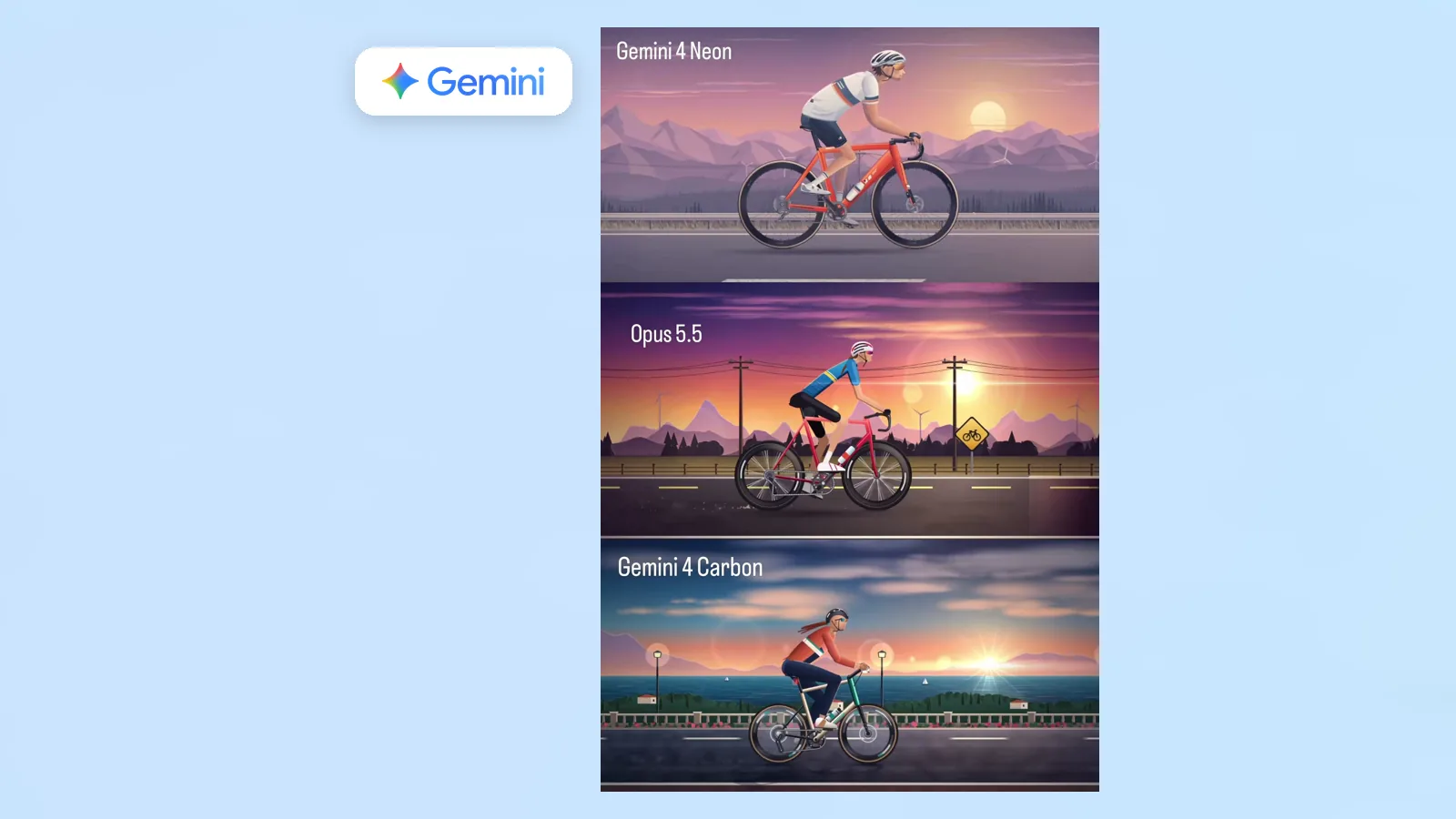
A 3D cyclist: Neon beats Opus. Pranav Reddy, who tests and trains models, asked three models for a 3D scene of a cyclist and posted all three on one screen. In his view, "Neon beats Opus 5.5 and is very close to Carbon's level of performance." This was the most widely shared clip on launch night. It was posted a quarter of an hour before the official announcement, when the model was already open to everyone in AI Studio, and he didn't state a thinking level.
Pranav Reddy on X: a 3D cyclist, Gemini 4 Neon vs Opus 5.5 vs Carbon, November 18, 2026
A convenience store on a rainy night: a letdown against Sol. Super Niu, an independent developer from China, asked Neon and GPT-6.2 Sol for the same scene: a convenience store on a rainy night. By his account, Neon is very fast and cheap, but its result is disappointing next to Sol's. This was the most-viewed comparison between Neon and another model on launch night. Here too the replies were split: one person wrote that Gemini's lighting is better, and GPT's buildings are more detailed.
Super Niu on X: a convenience store on a rainy night, Gemini 4 Neon vs GPT-6.2 Sol, November 18, 2026
A pagoda gate, four models: each one has something. Sree, who compares models in 3D, gave the same task to Neon, GPT-6.2 Astra, Opus 5.5 and Argon. He didn't pick a single winner: Neon is "closest to the prompt," Astra is the most ornate, Opus has the best night mood, and Argon's materials "feel off." The comparison also puts Argon next to the models that followed it.
Sree on X: a pagoda gate in Gemini 4 Neon, GPT-6.2 Astra, Opus 5.5 and Argon, November 18, 2026
Against Fable 5.2: Fable wins, and Neon even cost more. thehype, an account that posts model comparisons and points to a service that sells access to them, asked both models for a scene of Lego Ninjago figures. Fable built it out of bricks for $11.19, with the figures filling the screen. Neon cost $12.93 and left them small on an empty stage. It's the only comparison against Fable with a clear verdict, and it runs against the "half price" headlines: a single task can turn out more expensive on Neon.
thehype on X: a Lego Ninjago scene, Gemini 4 Neon vs Claude Fable 5.2, November 18, 2026
Two more tests back up the picture. Simon Willison, the developer who created the "pelican riding a bicycle" test, asked Neon at Low to draw the pelican, and wrote: "Pelicans do indeed sit between Hydrogen and Carbon/Argon." And WorldofAI, a YouTube channel with a quarter of a million subscribers, tested Neon in a 20-minute video. In a medieval battle scene, Fable 5.2 came out prettier, while Neon finished faster and at about half the cost. In his view, "the difference in quality isn't massive enough to ignore these advantages." About a shooter game he built, he said he could have gotten a better result with Opus. The video is sponsored, and most of its tests were one-shot.
Google promised improvements in coding, professional work, agent tasks and speed. Here's how that looks after the first night:
What Google promised, against the tests
Green: proven in independent tests. Orange: an improvement, with a caveat. Red: the opposite of what was promised, in some cases. Sources: Arena, Vals, Mercor, Andon Labs and Artificial Analysis; kimmonismus and Elliot Arledge on X. All from November 18, 2026. The benchmarking organizations and the early tester had access before launch.
The picture fits the benchmarks. In visual scenes built in a single attempt, there's no consistent winner: Neon sometimes beats Opus, and sometimes loses to Sol and Fable. It stands out somewhere else: agent work, step by step, where it has to follow instructions, use tools and not make things up. And that's exactly the work most business agents do.
The catch: writes fast, thinks slowly
When Artificial Analysis measures "fast," it measures how many tokens per second the model writes, and here Neon really is fast: about 100 to 110, twice Carbon's rate. But before it writes the first word, it thinks, and that takes time:
Seconds until the first word appears
Source: Artificial Analysis, Neon page data, November 19, 2026. In a conversation that's already under way, times are shorter: about 23 seconds at High and about 10 seconds at Low.
An independent test found the same thing. Elliot Arledge, an engineer who works on running models, asked eight models the same question about a bug in some code. Astra and Opus 5.5 finished answering in about 20 seconds, and Neon after 76. By his account, Neon thinks 3 to 20 times longer than the others before it answers.
For a business, this splits in two. In background work, like a monthly report, competitor research, a contract review or updating dozens of products on a website, nobody is waiting for the first word. There, Neon finishes the whole task faster than Carbon, and 40 seconds of thinking change nothing. In a live chat with a customer, on your website or on WhatsApp, 40 seconds of silence is an eternity. There you need Low or Medium, or a different model. Even at Low the first message takes about 14 seconds, and each later message in the conversation about 10. And for voice calls, it's not a fit at all.
One more thing about thinking levels: Xhigh is almost never worth it. According to Artificial Analysis, going from High to Xhigh adds less than two points, and costs 72% more money and 45% more time. On Vals too, High keeps 98% of the score at about half the cost. Google itself recommends testing all four levels and choosing the lowest one that clears the bar.
What still doesn't work
- An early tester counted 57 "no capacity available on the server" errors, and four runs that stopped midway. Some of that may be pre-launch load
- On one channel at OpenRouter, a service that connects to many models through a single account, the model was available 93.3% of the time during the half hour checked
- An agent that runs unsupervised needs a retry mechanism
- Most complaints are aimed at Antigravity, Google's coding tool: broken permissions and endless approval prompts
- One developer summed it up: "Neon is actually an okay model, but Agy [Antigravity] holds it back"
- Through the API, in other tools, the picture isn't clear yet
- Hebrew: no public test at all
- Google's full safety report: "coming soon"
- Epoch AI, ARC-AGI and independent coding tests: not published yet
Sources: kimmonismus and rohit3a on X; OpenRouter; Google's model card. November 18–19, 2026.
One more point about Google's own benchmarks. In some of them, the difference comes from the tool the model works in, not just the model. The tool, sometimes called the harness, is the software that runs the model: it gives it access to files and commands and manages its steps. On one bug-finding benchmark, Neon scored 39% and Opus 5.5 scored 10.1%. But Neon worked in Google's tool, which runs several agents in parallel, while Opus worked in Claude Code. When you run them all in the same simple tool, Neon scores 12.8%, Opus 3.6%, and GPT-6.2 Sol, which scored 8.3% in OpenAI's tool, jumps to 11.6%, almost level with Neon. Compared in the same tool, Neon still leads Opus, but its edge over Sol almost disappears.
Which model to run in your business agent
- Research, summaries and reports
- Documents, finance and contracts
- Multi-step tasks with tools
- Answers where a made-up one costs money
- The same quality in the middle range, for less than a third of the price
- Answers within about 3 seconds
- But makes things up far more: 55% vs 14%
- 40 seconds to the first word
- For chat: Low or Medium, or a different model
- For design and complex code: Claude still leads
If your agent runs on Gemini 4 Carbon, switching to Neon at High is almost a no-brainer: the same score, in less than half the time, and already 24% cheaper per task today. From December 1 it's less than half the cost. Carbon stays for the hardest problems, like long research. An Artificial Analysis employee also wrote that it's still Google's model for especially long work. If it runs on Argon, it's time to move: to Hydrogen for everyday work, or to Neon for harder tasks.
If it runs on Claude, Neon is the first reason in a while to take a serious look at Google. In professional work and agent tasks it's on par with Opus 5.5, at a third to half the cost, and with far fewer made-up answers. But for complex coding, design and creative tasks, testers still prefer Claude Fable 5.2 and Opus. If it runs on GPT-6.2 Sol, there's no reason to rush: Sol is cheaper and answers faster. The difference is in made-up answers, and if your agent handles questions whose answers aren't in its documents, Neon is worth testing.
Either way, test on your own tasks. A benchmark is an average of tasks that aren't yours. Ten real tasks, with the same instructions, on two models, will tell you more than any table.
What I'm doing with this
I usually build agents on Hermes Agent, an open-source framework from Nous Research, and pick the model that fits each business: from OpenAI, Anthropic, Google and others. Platin Digital is an OpenAI Select Partner, and that doesn't change the choice. I'm adding Gemini 4 Neon to my testing as a model for background work where accuracy matters: reports, research and documents. In that test, the first thing I check is Hebrew, because there's no data on it yet.
In the Sigma AI Ranking, our ranking, Neon will be added after its first week of independent measurements. Also in this series: Gemini 4 Carbon, Google's most powerful model, and GPT-6.2 Astra and Sol, OpenAI's launch from the day before. We broke down what an agent costs beyond the model itself in how much an AI agent costs a business.
Frequently asked questions
What is Gemini 4 Neon?
Gemini 4 Neon is a Google model released on November 18, 2026, sitting between Gemini 4 Hydrogen, the everyday model, and Gemini 4 Carbon, Google's most powerful model. Google aims it at coding, professional work and agents that carry out multi-step tasks. It's available in the Gemini app for Pro and Ultra subscribers, in Antigravity, in GitHub Copilot and in the paid API, under the name gemini-4-neon.
How much does Gemini 4 Neon cost?
In the API it costs $3 per million input tokens and $15 per million output tokens, and thinking tokens also count as output. The price stays the same even when you feed it very long text, up to about a million tokens. Cached input costs 15 cents, a 95% discount. There's no introductory price and no free tier. On the Artificial Analysis index, a task at the default level costs it $3.74, less than half of Carbon at its regular price and 37% of Claude Opus 5.5.
Is Gemini 4 Neon better than Claude Opus 5.5?
On independent benchmarks, they're at the same level: Neon scores 60 at High and 61 at Xhigh, and Opus 5.5 scores 59 at maximum thinking. Neon costs much less per task and makes up answers far less often: 14% versus 50%. In the comparisons developers posted, the results are mixed: sometimes Neon wins, sometimes Opus. For complex coding, testers still lean toward Claude.
What's the difference between Gemini 4 Neon and Gemini 4 Carbon?
In overall quality they're almost identical: 61 for Neon at Xhigh, and 60 for both at High. The difference is in time and price: Neon writes twice as fast and finishes a task in 15 minutes versus 36. Until November 30, Carbon is cheaper per token thanks to a promotion, and from December 1, Neon is 25% cheaper. For a whole task at High, Neon is already cheaper today, because it writes less. Carbon remains Google's model for research and especially long work.
Is Gemini 4 Neon a good fit for an agent that answers customers?
It depends on the channel. For the answers themselves it's a very good fit, because it makes things up far less than Anthropic's and OpenAI's models. But at the default level it takes about 40 seconds before it starts answering, and about 23 later in the same conversation. For live chat you need to run it at Low or Medium, where the wait is about 14 to 20 seconds for the first message, and check whether that response time works for you. For voice calls it's not a fit.
Did Google launch Neon because of the Anthropic IPO?
There's no evidence of that. Anthropic priced its IPO on the same day Neon came out, but no serious media outlet has linked the two. Google itself holds more than $100 billion worth of Anthropic shares, and it committed to buy more at the IPO price. In my view, Google is simply answering every competitor launch: Neon came out 27 hours after GPT-6.2.
Sources
- https://blog.google/innovation-and-ai/models-and-research/gemini-models/introducing-gemini-4-neon/
- https://antigravity.google/blog/gemini-4-neon-in-google-antigravity
- https://storage.googleapis.com/deepmind-media/Model-Cards/Gemini-4-Neon-Model-Card.pdf
- https://storage.googleapis.com/deepmind-media/gemini/gemini_4_neon_model_evaluation.pdf
- https://aistudio.google.com/docs/models/gemini-4-neon
- https://aistudio.google.com/docs/pricing#gemini-4-neon
- https://aistudio.google.com/docs/whats-new-gemini-4-neon
- https://aistudio.google.com/docs/choosing-a-model
- https://aistudio.google.com/docs/deprecations
- https://support.google.com/gemini/answer/18648722
- https://docs.cloud.google.com/gemini-enterprise-agent-platform/models/gemini/4-neon
- https://github.blog/changelog/2026-11-18-gemini-4-neon-in-github-copilot
- https://artificialanalysis.ai/models/gemini-4-neon
- https://artificialanalysis.ai/leaderboards/models
- https://x.com/ArtificialAnlys/status/2123170645777526962
- https://x.com/ArtificialAnlys/status/2123170648772288540
- https://x.com/ArtificialAnlys/status/2123170651980931421
- https://x.com/ArtificialAnlys/status/2123170658129768801
- https://artificialanalysis.ai/articles/gemini-4-argon-google-top-three-labs
- https://x.com/arena/status/2123169189397709174
- https://x.com/arena/status/2123169199396946279
- https://x.com/arena/status/2123169197182386372
- https://x.com/arena/status/2123192239761596566
- https://arena.ai/leaderboard/webdev
- https://www.vals.ai/models/google_gemini-4-neon
- https://x.com/andonlabs/status/2123174738789011875
- https://x.com/mercor/status/2123184025808650641
- https://x.com/kimmonismus/status/2123168557228011759
- https://x.com/mweinbach/status/2123173232425734293
- https://x.com/elliotarledge/status/2123200759819124893
- https://x.com/notjazii/status/2123172429791129848
- https://x.com/notjazii/status/2123166093422272839
- https://x.com/AI_Screening/status/2123164032882659819
- https://x.com/Super_Nius/status/2123169627815698522
- https://x.com/srikanthvaluri/status/2123187817899766190
- https://x.com/thehypedotnews/status/2123182627674796462
- https://x.com/IndependentEco/status/2123177347046355324
- https://news.ycombinator.com/item?id=50554129
- https://gist.github.com/simonw/abc5dfe18e8d37a46fd09a3dcc18ed5c
- https://www.youtube.com/watch?v=R0rXSJmymTc
- https://x.com/rohit3a/status/2123198172357091792
- https://x.com/Lentils80/status/2123180014870921337
- https://x.com/testingcatalog/status/2123133757615980707
- https://x.com/theo/status/2110461356935983257
- https://x.com/theo/status/2110462797440323798
- https://x.com/theo/status/2123207527064318174
- https://www.thestar.com.my/tech/tech-news/2026/10/02/google-grapples-with-employee-scepticism-about-new-gemini-4
- https://www.cnbc.com/2026/11/18/anthropic-ipo-ai-offering-price.html
- https://news.ycombinator.com/item?id=50552424
- https://news.ycombinator.com/item?id=50552868
- https://openrouter.ai/api/v1/models/google/gemini-4-neon/endpoints
- https://x.com/ml_angelopoulos/status/2123169986944586103
- https://x.com/ArtificialAnlys/status/2123170655424450840