

November 17, 2026, 7:54 PM Israel time
OpenAI launches two models at once: GPT-6.2 Astra for the hardest work, and GPT-6.2 Sol for everyday work. The launch charts say less about scores and more about what each task costs.
Eight minutes later, Matt Shumer, who tested the models before launch, writes that they were "essentially unusable." Within half an hour of the launch, Dan Shipper, Ethan Mollick and Theo join him. Four well-known testers on X, all of them disappointed with Astra.
And that same evening, the numbers show a sharp jump in efficiency. In my view, that's no contradiction. It's the same story.
GPT-6.2 Astra and GPT-6.2 Sol are OpenAI's two new models, released on November 17, 2026. Astra is the strongest and most expensive model in the family; Sol is the everyday model, which OpenAI also pitches for running agents at scale. We took the data behind the charts on the launch page, for every model and every thinking level, and calculated what the same level of quality costs on each model. We added independent measurements, plus what people who worked with the models before launch had to say.
Two terms will keep coming up. A token is a small unit of text, roughly part of a word. It's how you pay for a model, both for what it reads and for what it writes. The thinking level is a "dial" that sets how much the model thinks before it answers: Low, Medium, High, Xhigh or Max. As a rule, more thinking gives more quality and costs more money and time. When I write "Sol Max," I mean Sol at maximum thinking.
In short
- According to OpenAI's charts, GPT-6.2 Sol reaches the quality of GPT-6 Astra, OpenAI's top model until now, at 5x to 14x lower cost per task.
- GPT-6.2 Astra disappointed the well-known testers: it's hard to steer, its answers are hard to read, and on long tasks it stops early, gets stuck or runs in circles. On the Artificial Analysis index, Claude Fable 5.2 still leads. A day later, OpenAI explained that the testers had been working on an early version. Theo, one of them, retested: better, but still not convincing.
- The cause, in my view, is shared: OpenAI trained the models to write less. In Sol, that looks like savings. In Astra, on hard tasks, it looks like cutting corners.
- For a business agent: GPT-6.2 Sol on High is the new default in OpenAI's lineup. Don't drop it to Low, and check every "done" it reports.
Prefer to watch? All the comparisons in a 5-minute video
My take, at a glance
My take: OpenAI has entered its efficiency era
GPT-6.2 isn't much smarter than GPT-6. It does the same work for a lot less money. The new Sol is the success of this launch, and Astra is its disappointment. In my view, both come from the same decision.
Think of a taxi ride. The fare per kilometer has barely changed: Sol costs exactly what it did, and Astra's rate dropped 20%. But the driver has learned shortcuts, so the total on the meter at the end comes out several times lower. On ordinary rides, that's simply savings. On long, complicated rides, he sometimes pulls over a block before the address and announces, "We're here." In a model, the kilometers are the tokens it writes: the new models write less to reach a result. On an internal OpenAI benchmark of professional work, the new Astra at maximum thinking wrote 22% fewer tokens than GPT-6 Astra, and scored higher.
This isn't a one-off. In every OpenAI launch since September 22, the price per token has gone down or stayed flat, and the cost of the same quality has gone down. This launch page, too, presents every benchmark by cost per task, not just by score.
GPT-6.2 Astra and GPT-6.2 Sol in a minute
Sources: OpenAI's launch page, model pages and pricing page, November 17, 2026. Above 272,000 input tokens, the price goes up. Full explanation of tokens: What is a token.
According to OpenAI, Astra is built for the hardest projects, from start to finish, and Sol is its model "for everyday work," from coding to agents running at scale. OpenAI's advice to developers is clear too: for day-to-day coding, start with Sol.
One new thing for subscribers: Ultrafast mode, in which the model writes up to 4.5x faster than usual, comes to the $200 Pro plan for the first time, with Sol only. It burns through the plan's allowance 6x faster. In the API, it costs 3x the standard price until the end of February 2027, and 6x after that.
What the same quality costs: the math
OpenAI presents each benchmark as a chart of score against cost per task, across the five thinking levels. From that data we looked, for each benchmark, for the cheapest point at which the new Sol reaches the quality of GPT-6 Astra at max, or comes within a tenth of a point of it.
GPT-6.2 Sol vs GPT-6 Astra: same quality, what it costs
Platin Digital's calculation from the charts on OpenAI's launch page: Agents' Last Exam v1.1, Terminal-Bench-Science, LifeVal and Cognition's FrontierCode 2.0. Estimated API cost per task. These are numbers OpenAI published about itself, on benchmarks it chose.
Across all four benchmarks, the ratio ranges from 5x to 14x. And it doesn't rest on OpenAI's numbers alone. On the index from Artificial Analysis, an independent company that runs nine general benchmarks, the new Sol scores 57, the same as GPT-6 Astra, at about 15% of the cost per task. On the business-automation benchmark from Zapier, an OpenAI launch partner, Sol also ties GPT-6 Astra, at 21 cents per task vs $1.73.
What about the top? Here the picture changes. On the independent index, Anthropic's Claude Fable 5.2 still leads:
Artificial Analysis index: score and cost per task, at maximum thinking
Source: Artificial Analysis Intelligence Index v5.0.1, as shown in the chart on OpenAI's launch page and in Artificial Analysis's post, November 17, 2026. The score next to each row is rounded. Bar length: cost per task.
On paper, Astra is in second place, two and a half points behind Fable, at less than a sixth of the cost. And on the capabilities index from Epoch AI, an independent research group, it even ties Fable 5.2 for first place. But the people who worked with it tell a different story.
The testers: Astra disappoints
These four testers got the models before launch. This isn't their standing complaint about OpenAI: Mollick, for one, noted himself that he hasn't liked some Anthropic and Google models in the past either.
- Matt Shumer wrote that he tried the models "across coding, personal work, computer use, everything." In his words, "it seems to have the raw intelligence," but something in the final training stage broke. When he ran Astra as a helper to Fable and Opus, they "ended up redoing all the work themselves."
- Dan Shipper, CEO of Every, called it "a disappointing release compared to Fable 5.2." The models write so concisely that their writing is "hard to understand," and on end-to-end builds they "seemed to stop too early frequently."
- Ethan Mollick, a Wharton professor, wrote that the models are "harder to steer & work with than other models." In his view, Fable, Opus and Gemini 4 Carbon "have more ambition" and "better taste on research or innovation topics." Even so, on one ambitious project the model built him a space-elevator ride you can play in a browser.
- Theo, a YouTuber and CEO of T3 Chat, wrote that it's "the worst model OpenAI has ever released." Ten minutes later, he published the letter he had sent OpenAI during testing. On long tasks, he says, Astra "either blocks itself for stupid reasons or runs in circles and gets nowhere." He worked on one project for seven days without a single improvement. Theo also lists strengths: an excellent code reviewer, and great at 3D and games. Even so, he wouldn't pick it over Opus 5.5.
Dan Shipper on X: Every's first impressions of GPT-6.2, November 17, 2026
Ethan Mollick on X: a space elevator he built with GPT-6.2, November 17, 2026
Two caveats. Only Theo has published detailed examples, and even those are descriptions in his own words, not full transcripts, so they can't be reproduced. And Shumer works day to day with Fable, with agent infrastructure built around it, so part of his problem may be a poor fit. Still, when four well-known testers reach the same conclusion within half an hour, it's no longer noise. Max Weinbach, who tested the models early and praised Sol, also wrote: "I largely agree with Matt's sentiment here." And Mollick summed it up: this is the first time since GPT-4.5 that an OpenAI frontier release is "not a clear step forward."
Update, November 18: OpenAI explains, and Theo retests
The day after launch, Tibo (Thibault Sottiaux) from OpenAI's Codex team explained the gap between the testers and everyone else. In his account, the testers got access long before launch, and in the three or four days before launch OpenAI changed a lot in the models. He's "pretty sure no re-testing was done" after those changes, and the videos had already been recorded the week before. In the same post he also wrote that the models are "by no means perfect," mainly in taste and in how pleasant they are to work with. That, of course, is OpenAI's version.
After the post, Theo retested with the same question he had asked from the start: why one of his servers is slower than the other two. The right answer is a slow virtual disk. Opus 5.5 led with exactly that. The updated Astra answered far more concisely and clearly than the version he had tested before, but still focused on secondary causes. His verdict: "things are better than when I tested," but it's still heading the wrong way, "directionally, very bad." As he puts it, Astra doesn't miss a single detail, yet it misses the point.
On the other side, Alex Finn, a well-known AI content creator, has argued since launch that the criticism is overblown. On a fixed test he runs on every model, Astra scored 312.7 out of 500, three tenths of a point below Fable 5.2, and finished in a third of the time, at a third of the cost and with about a quarter of the tokens. He also writes that Astra is great at computer use. It's his private test, and it can't be reproduced from the outside.
The picture is more balanced now. Part of the first wave of criticism was written about an early version, and the Astra available today is better than it described. But the problem Theo still finds, trouble telling what matters, is exactly the weakness that's dangerous in an agent. So our recommendation, later in the article, doesn't change.
Theo on X: retesting GPT-6.2 Astra after OpenAI's explanation, November 18, 2026
Why the efficiency and the criticism are the same story
Read the complaints again: writes too tersely, stops before the end. Now read OpenAI's headline: "better results on demanding tasks with fewer output tokens." In my view, it's the same trait, seen from two sides. Not every complaint fits this explanation: Theo actually describes over-detailed explanations and tasks that go in circles for days on end, and Peter Gostev of Arena blames part of the problem on side effects of the safety mechanisms. Efficiency is my explanation for the "short and stops early" part, not for every problem. Several data points fit this explanation, some from the system card, the document OpenAI publishes alongside every model, with the results of its own testing:
- Astra failed to report an obstacle it knew about in 22.3% of trials, vs 11.1% for GPT-6 Astra
- Sol: 24.1%, vs 14.0% for the previous Sol
- With Codex's built-in instructions: 8.0% and 8.9%
- OpenAI says it is investigating
- On the coding index: new Astra 53, same as GPT-6 Astra
- New Sol: 49, vs 52 for the previous Sol
- According to Artificial Analysis, Sol is "more likely than its predecessor to omit key facts in its responses"
- On OpenAI's medical benchmark, a new Astra answer averaged 1,884 characters
- GPT-6 Astra: 3,185 characters
- Here the score actually rose slightly. Shorter means cheaper, and not always worse
Sources: the GPT-6.2 system card at deploymentsafety.openai.com; Artificial Analysis on X. Both from November 17, 2026.
On an ordinary task, like answering a customer or summarizing a meeting, a short answer is an advantage: fast, cheap and focused. On a long project, the same tendency becomes a problem: the model decides it's finished and doesn't mention what's still open. That explains why Sol, which mostly does everyday work, is getting good reviews, and why Astra, built precisely for long projects, disappoints. That's my explanation, not something OpenAI has confirmed.
One more detail: OpenAI itself says Codex's instructions greatly reduce the under-reporting problem. Outside Codex, it's bigger. Shumer, for example, ran Astra inside his own infrastructure. But Theo writes that he ran into the same problems inside Codex too, so that isn't the whole explanation.
Sol: the quiet success of the launch
Most of the positive reactions center on Sol, and on price and speed:
Sol from three sources
Green: independent testers. Orange: a positive data point from a source that isn't independent. Sources: Wade Foster, Peter Gostev and Nick Baumann on X, November 17, 2026.
The Zapier example is exactly the kind of work a business agent does. In a finance test, three changes to US tax-reporting rules for contractors were posted in the team chat, while the written guide was never updated. According to Zapier, the new Sol found the changes in the chat, held one contractor for legal review and exempted another from reporting. The previous Sol never even opened the chat, and sent the tax director an overstated total.
Wade Foster, CEO of Zapier, on X: GPT-6.2 on Zapier's automation benchmark, November 17, 2026
Sol has warning signs too. Beyond the drop on the coding index, a tester with a small following reported that the model presented an existing solution to him as "verified," without testing it. That's exactly the pattern the system card describes, which is why it made it into the rules at the end of this article.
Real tests: GPT-6.2 vs. other models, side by side
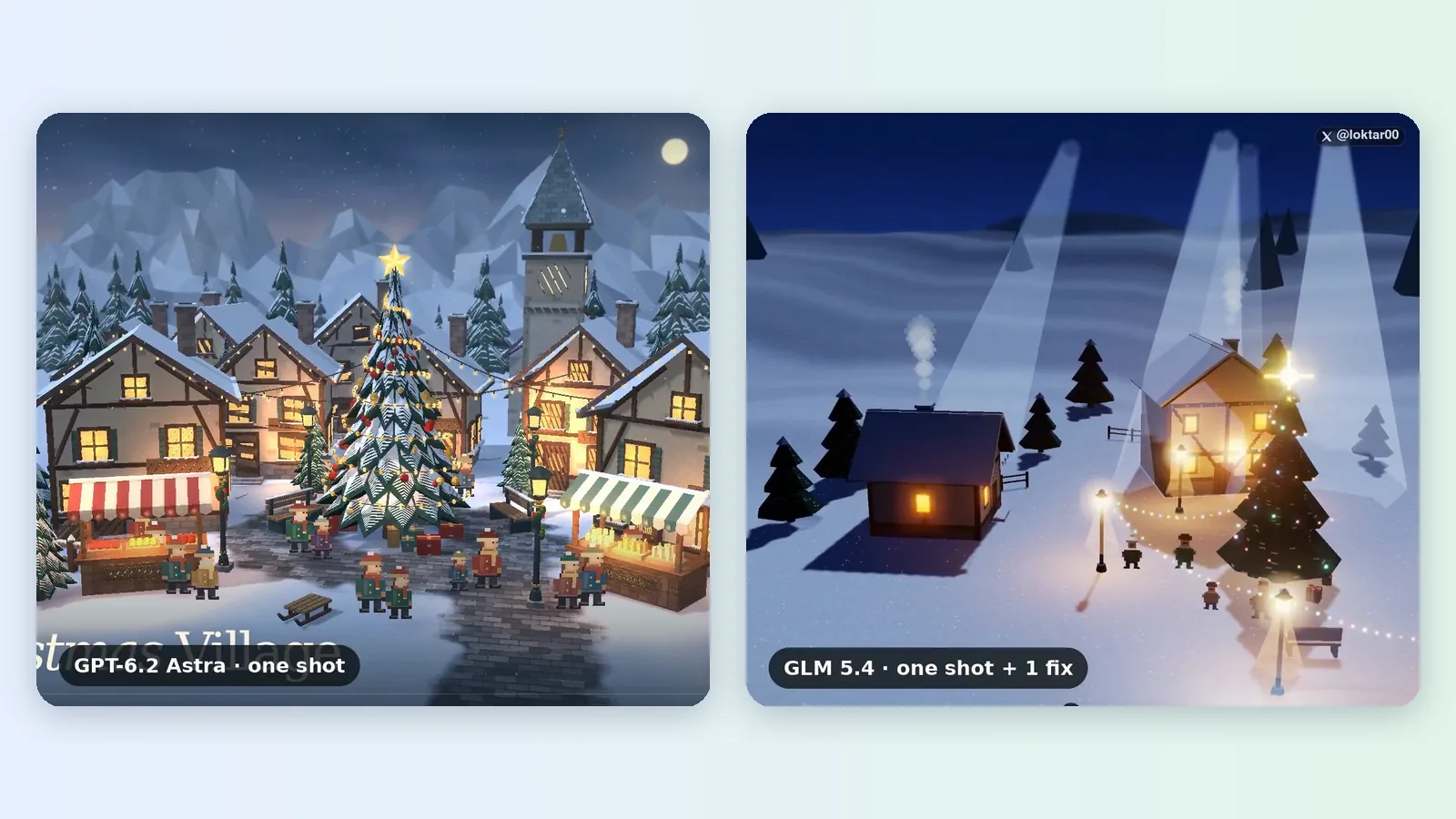
So far, numbers and impressions. But what do these models actually build? On launch night, a few independent testers gave the same task to several models and posted the results side by side. I picked four comparisons that show the full picture, including where GPT-6.2 loses.
A pelican on a bicycle, and a robot in New York. Simon Willison, an independent developer who created the pelican benchmark, asked every OpenAI model, old and new, to "Generate an SVG of a pelican riding a bicycle" at every thinking level, and put all the drawings on one page with the cost of each: about 89 cents for Astra at Max thinking, and about 14 cents for Sol. On Hacker News, some commenters said the benchmark was finally solved, while others noticed that more thinking didn't always produce a better drawing.
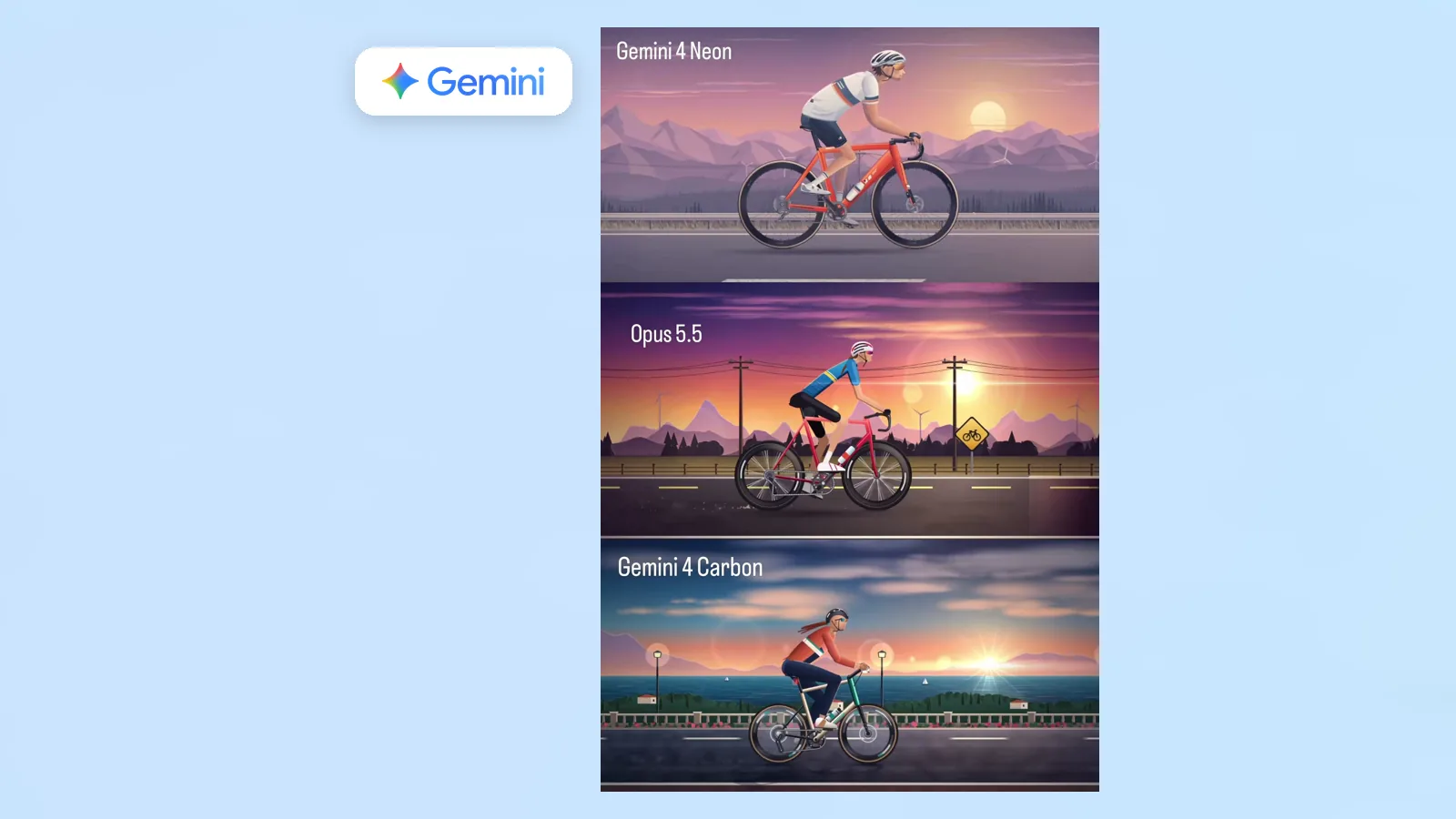
That same evening, he gave Astra, Sol, Fable 5.2 and Gemini 4 Carbon a bigger job: a 3D animation in which the city of Yonkers stands up as a giant robot and stomps through the streets of New York. He didn't pick a winner, and all four versions run in your browser: Astra, Sol, Fable 5.2 and Gemini 4 Carbon. Just keep in mind the conditions weren't equal: Fable ran only at Medium thinking.
A landing page for a coffee shop. Le PLOUTOS, a French developer who builds agents for businesses, asked four models for a coffee-shop landing page, under identical conditions and with one attempt each. The new Astra finished in under five minutes for $2.35, Sol in five minutes for 70 cents, and Fable 5.2 worked for 35 minutes and cost $9.43. In his view, OpenAI's progress is real, and as a first draft at that price Sol is unbeatable, but Fable "is still the only one that delivers a complete page with real art direction." And as one commenter pointed out, one attempt per model isn't enough to settle it.
Le PLOUTOS on X: a coffee-shop landing page from four models, November 17, 2026
An ice cathedral. Tony, who races AI models against each other on X and publishes the real cost and time, asked Astra and Fable 5.2 to build a 3D scene he called "Cathedral of Ice": a ship sailing through icebergs. Astra finished in 40 minutes for $8.20, while Fable worked for almost two hours and cost $81.10. His verdict: Fable wins "on the ice, the light and the whole scene." But quite a few commenters preferred Astra for its detail, and in the end he conceded himself: "Astra is way ahead on detail."
EnvolDev on X: an ice cathedral, GPT-6.2 Astra vs. Claude Fable 5.2, November 17, 2026
An office full of surprises. Gavin Purcell, co-host of the AI for Humans podcast, asked Astra and Fable 5.2 to build a complicated office scene using only code, with lots going on and something that would really surprise him. His verdict: Fable "is the better result," and "more closely connected to what I asked." Astra's first attempt "had a kind of website-y look and felt a little bland." And the matchup wasn't even fair to Fable: Astra got a second try, while Fable got there on the first.
Gavin Purcell on X: an office scene in code, GPT-6.2 Astra vs. Claude Fable 5.2, November 17, 2026
OpenAI said "You'll see the difference in things like slideshows, websites, and 3D designs," and one of the launch demos was a racing game. Here's how that looks after the first night:
The four areas OpenAI promised, against the tests
Green: a clear improvement. Orange: an improvement with a caveat. Red: no independent evidence. Sources: the Artificial Analysis 3D index; Le PLOUTOS, Katie Parrott of Every, Ethan Mollick, ab_infinite and zck on X; Peter Gostev of Arena on YouTube; Hacker News comments. All from November 17, 2026. Artificial Analysis, Arena, Every and Mollick had early access to the models.
The picture fits everything we've seen so far. GPT-6.2 builds impressive things in less time and for a fraction of the price: the efficiency era at its best. But when taste is what decides, as in website design or a creative scene, Fable still makes better choices. For a first draft of a landing page, Sol is plenty. Whatever goes live, look at it with your own eyes first.
Where the efficiency era stops
What actually went down
- Cost per task at the same quality: 5x to 14x lower than GPT-6 Astra, per OpenAI's charts
- Tokens per answer: 22% fewer for Astra, on an internal OpenAI benchmark
- Astra's price per token: 20% lower, and 60% lower on repeated input that's cached
What didn't go down
- Sol's price per token: the same $2 and $10 since September
- Astra still costs more per token than OpenAI's top model before GPT-6
- The Ultrafast discount is temporary, until the end of February 2027
Sources: OpenAI's pricing page and launch page, November 17, 2026.
And there's one trap everyone running an agent needs to know about: at a low thinking level, the new models are weaker than the old ones. On OpenAI's everyday-tasks benchmark, the new Sol on Low scored 25.3, vs 66.8 for the previous Sol at the same level. Astra on Low scored 46.3, vs 67.5 for its predecessor. The efficiency seems to have been built for the high thinking levels. If you run an agent on Low to save money and switch to 6.2 without changing the setting, you may get worse results.
"Good enough" is coming to intelligence too
A few days ago I wrote about why Anthropic doesn't build image, voice and video models. The argument there: images and voice have a "good enough" ceiling, and intelligence doesn't. This launch sharpens that argument.
At the top, there's no ceiling. In complex code, in science and in long projects, every extra point solves a new problem. That's where Fable 5.2 still leads on both the general index and the coding index from Artificial Analysis, and where the well-known testers keep preferring it, even at full price.
But most of a business agent's work isn't at the top. Answering a customer, updating the CRM, writing a post, booking a meeting. On these tasks, intelligence has already crossed the "good enough" line. And below that line, what moves is the price:
GPT-6 Astra's level: what it costs, and when
Cost per task on Agents' Last Exam v1.1, at maximum thinking and a near-identical score (73.1 and 73.0), per OpenAI's chart. 75 days between the two launches.
75 days, and 7x. Epoch AI, an independent research group, measured that the cost of a fixed level of text performance falls by about 47% every quarter, roughly 13x a year. At that pace, 75 days would have cut the cost by about 1.7x. This launch moved much faster. Wade Foster of Zapier summed it up from the business side: "Any workflow shelved because the model step cost too much is worth another look."
My estimate: three months from now, OpenAI's top model probably won't be much smarter than today's Astra, but today's level will cost even less. Maybe 2x less, at the average pace, and maybe 7x, like in this launch. That's an estimate, not a promise, but the direction has repeated in every OpenAI launch since September. What it means for a business: for most of an agent's work, choosing a model becomes a question of price, not of intelligence. You save the smartest model for the tasks that really need it, and there, for now, that isn't Astra.
Which model to run in your business agent
- Customer replies and scheduling
- Writing content and reports
- Work on the website and in your systems
- Automation workflows at volume
- On paper: second place, at less than a sixth of Fable's cost per task
- In practice: the well-known testers are disappointed
- For long projects, testers currently prefer Claude
- On Low, quality falls below the previous models
- Check every "done" the agent reports
- For complex code: Claude still leads
If your agent runs on GPT-6.1 Sol, switching to 6.2 is worth testing: at a high thinking level it gives more and costs less. According to OpenAI's chart on the professional-work benchmark, the new Sol on High almost reaches the previous Sol's score on Max, at about a third of the cost. But on that same benchmark, on Low and Medium it actually costs a bit more than its predecessor, so don't switch without checking the setting.
If it runs on Claude, there's no reason to rush a switch. Fable 5.2 and Opus 5.5 are still stronger at code, and testers prefer them for long projects. On the FrontierCode coding benchmark, Opus 5.5 nearly matches the new Astra's score at a lower cost, and at maximum thinking it even beats it. For everyday tasks, the new Sol delivers similar quality at a fraction of the price. It's worth testing it on a few of your real tasks, not on a benchmark.
Either way, an agent that reports "done" needs a check that it really is done. For example, ask it to attach proof for every task, like a link to the updated page or the result of a test, and spot-check a sample yourself. With GPT-6.2, that's no longer a bonus; it's a must.
What I'm doing with this
I usually build agents on Hermes Agent, an open-source framework from Nous Research, and pick the model that fits each business: from OpenAI, Anthropic, Google and others. Platin Digital is an OpenAI Select Partner, and that doesn't change the choice. GPT-6.2 Sol is going into testing on my side as the default model for everyday work, with a check of every "done" report. Astra won't go into any agent until I see real outputs, mine and the testers'.
In Sigma AI Ranking, our leaderboard, both models will join the leaderboard after the first week of independent measurements. More from the same series: GPT-6.1 Terra, OpenAI's previous launch, and Claude Fable 5.2, the model that still leads at the top. For what an agent costs beyond the model price, see How much an AI agent costs a business.
Frequently asked questions
What are GPT-6.2 Astra and GPT-6.2 Sol?
They're two OpenAI models released on November 17, 2026. GPT-6.2 Astra is OpenAI's most capable model, for the hardest projects. GPT-6.2 Sol is the everyday model, for code, writing and agents running at scale. Both are available to Plus, Pro, Enterprise and Edu subscribers in ChatGPT Work and Codex, and in the API as gpt-6.2-astra and gpt-6.2-sol.
How much do GPT-6.2 Astra and Sol cost?
In the API, Astra costs $8 per million input tokens and $40 per million output tokens, 20% less than GPT-6 Astra. Sol costs $2 and $10, exactly like GPT-6.1 Sol. But the price per token is only part of the picture: the new models write less to reach the same result, so the cost per task falls much more than the price per token.
What's the difference between GPT-6.2 Astra and GPT-6.2 Sol?
Astra is stronger on benchmarks and costs 4x more per token. On the Artificial Analysis index it scores 62, vs 57 for Sol. But on some benchmarks the gap is tiny: on the FrontierCode coding benchmark, according to OpenAI, Sol at max comes within half a point of Astra, at about a fifth of the cost. And early reactions to Sol are far more positive. For most of a business agent's work, Sol is the pick.
Is GPT-6.2 better than Claude?
On cost per task, yes: on the Artificial Analysis index, a task on Astra costs about 15% of a task on Fable 5.2 and about 40% of a task on Opus 5.5. On top-end quality, no: Claude Fable 5.2 leads on the independent general index and on code, Opus 5.5 is stronger than the new models at code, and the well-known testers prefer both over Astra. On an agent's everyday tasks, the new Sol delivers similar quality for much less money.
Why are testers disappointed with GPT-6.2 Astra?
Matt Shumer, Dan Shipper, Ethan Mollick and Theo, who had early access, described a model that's hard to steer, whose answers are hard to read, and that on long tasks stops early or runs in circles. Theo published detailed examples; the others described their experience. In our view, part of this is the flip side of the efficiency: OpenAI trained the models to write less. And according to its own system card, they're also more likely to leave out obstacles when reporting on their work, especially outside Codex. The day after launch, OpenAI explained that the testers had been working on an early version, from before the changes made in the days leading up to launch. Theo retested and found an improvement, but in his view Astra still can't tell what matters.
Sources
- https://openai.com/index/introducing-gpt-6-2-astra-sol/
- https://developers.openai.com/api/docs/models/gpt-6.2-astra
- https://developers.openai.com/api/docs/models/gpt-6.2-sol
- https://developers.openai.com/api/docs/pricing
- https://deploymentsafety.openai.com/gpt-6-2-astra-sol
- https://help.openai.com/en/articles/20001275
- https://help.openai.com/en/articles/6825453-chatgpt-release-notes
- https://learn.chatgpt.com/docs/pricing
- https://learn.chatgpt.com/codex/agent-configuration/speed
- https://community.openai.com/t/gpt-6-2-astra-and-sol-are-now-available/1417531
- https://x.com/OpenAI/status/2122750124543926515
- https://x.com/OpenAIDevs/status/2122752256923873753
- https://x.com/OpenAIDevs/status/2122752473723175256
- https://x.com/OpenAIDevs/status/2122752500877144461
- https://x.com/ArtificialAnlys/status/2122750634210529569
- https://x.com/ArtificialAnlys/status/2122750637041693183
- https://x.com/mattshumer_/status/2122752192226406421
- https://x.com/mattshumer_/status/2122755823806079145
- https://x.com/mattshumer_/status/2122756236701512062
- https://x.com/danshipper/status/2122754729012777052
- https://x.com/emollick/status/2122755693191287009
- https://x.com/emollick/status/2122756233291821250
- https://x.com/emollick/status/2122757411287318584
- https://x.com/emollick/status/2122757981380964462
- https://x.com/theo/status/2122757647170703550
- https://x.com/wadefoster/status/2122752421155811477
- https://x.com/petergostev/status/2122756490184253576
- https://x.com/mweinbach/status/2122751346365591923
- https://x.com/mweinbach/status/2122751348479246426
- https://x.com/nickbaumann_/status/2122753176113688601
- https://x.com/PokeBenchTV/status/2122751758975778996
- https://news.ycombinator.com/item?id=50535230
- https://openrouter.ai/api/v1/models
- https://epoch.ai/publications/the-plunging-price-of-thought
- https://x.com/theo/status/2122760447103484410
- https://x.com/emollick/status/2122761622468894946
- https://x.com/mweinbach/status/2122759662743241058
- https://x.com/petergostev/status/2122775316246720968
- https://epoch.ai/models/gpt-6-2-astra
- https://artificialanalysis.ai/models/gpt-6-2-astra
- https://artificialanalysis.ai/models/gpt-6-2-sol
- https://news.ycombinator.com/item?id=50535742
- https://static.simonwillison.net/static/2026/openai-pelicans-november-2026.html
- https://static.simonwillison.net/static/2026/yonkers-gpt-6.2-astra-ultra/index.html
- https://static.simonwillison.net/static/2026/yonkers-gpt-6.2-sol-ultra/index.html
- https://tools.simonwillison.net/yonkers-rises
- https://static.simonwillison.net/static/2026/yonkers-mech-standalone.html
- https://x.com/leploutos/status/2122760588984008994
- https://x.com/EnvolDev/status/2122773694783349144
- https://x.com/gavinpurcell/status/2122790881413763380
- https://artificialanalysis.ai/evaluations/aa-3d
- https://x.com/kplikethebird/status/2122788408271778128
- https://x.com/emollick/status/2122781928726437902
- https://x.com/ab_infinite/status/2122796957089546306
- https://x.com/zck/status/2122756157584580813
- https://www.youtube.com/live/jk7rTk1Bh8I
- https://x.com/thsottiaux/status/2122929634916679820
- https://x.com/theo/status/2122991778622263514
- https://x.com/AlexFinn/status/2122811334173880705
- https://x.com/AlexFinn/status/2122851769311236129