

November 23, 2026, 04:18 UTC
No event, no big announcement, no score table: Z.ai quietly opens GLM-5.4 to subscribers of its coding plan. Six hours later comes a technical post explaining how the model is built. Still no benchmark scores.
So developers test it themselves. One gets a floating island that beats DeepSeek's. Another waits an hour for a drawing of a game controller. A third waits "forever," and gets an error message.
The model has improved a lot. But it's still nowhere near the American top tier.
GLM-5.4 is the new flagship model from Z.ai, a Chinese AI company formerly known as Zhipu, released on November 23, 2026. I went through the official post, the terms and the comparisons developers published on day one. And I checked where the models it's being compared with stand on an independent index.
In short
- GLM-5.4 is much better than GLM-5.3, especially in 3D, animation and games.
- But it's far from the American top tier. In every serious test, Opus 5.5, Gemini 4 Neon and GPT-6.2 Astra came out ahead of it. By Z.ai's own data, it's roughly at DeepSeek's level, and in my view that's the level of American models from two generations ago.
- And it's very slow: it thinks a lot before it answers, and Z.ai itself admits it.
- Today it's only available through a subscription for coding tools, from $18 a month. No API and no official scores. For a business agent: no.
Prefer to watch? The guide in a 6-minute video

GLM-5.4 vs. each model, in day-one tests
- GLM-5.3The previous versionGLM-5.4 is much betterOn the same drawings and animations, you can see the difference. But it works 3x longer
- Qwen4-MaxBy AlibabaGLM-5.4 is betterIn one test: its floating island came out complete, while Qwen's water didn't connect to the island
- DeepSeek V4.1 FlashThe cheap open modelAbout the same levelGLM-5.4 came out ahead in three small tests, but in Z.ai's own chart it's nearly a tie
- Gemini 4 HydrogenBy GoogleHydrogen is betterHydrogen drew the pelican and the bike better, and finished in minutes. GLM-5.4 worked for an hour
- GPT-6.2 AstraBy OpenAIAstra is betterAstra built a full Christmas village on the first try. GLM-5.4 returned an error, and after a fix delivered a sparse village of a few houses
- Claude Opus 5.5By AnthropicOpus is betterOpus won two head-to-head tests. GLM-5.4 is much cheaper, but not at the same level
- Gemini 4 NeonBy GoogleNeon is betterIn two head-to-head comparisons, the testers preferred Neon. On a long coding benchmark, Neon also finished 4x faster
Each row is based on one to three developer tests, not on a measurement. There were also two "wins," over Opus and over Astra, each in a single run, from a small account or from someone promoting Z.ai. In the "win" over Opus, in my view GLM-5.4 actually produced the weakest result. Details below.
My take: a big upgrade, but nowhere near the top
GLM-5.4 doesn't come close to the leading models from Anthropic, Google and OpenAI. It's a big upgrade over GLM-5.3, no doubt about that: you can see the difference. But against Opus 5.5, Gemini 4 Neon and GPT-6.2 Astra, it lost every serious test I found.
And I take its few wins with a grain of salt. At the launch of Kimi K3.1 Pro we already saw a brief for influencers, with ready-made lines like "Open-source Opus." Here too, the "win" over Opus came from someone who was handing out Z.ai trial cards that same morning, in a single run, with GLM-5.4 at a higher thinking level. And when you watch the video, GLM-5.4's result is, to my eye, the weakest of the four. Z.ai itself hasn't published a single score.
So where does it really stand? There's one data point to hold on to, and it comes from Z.ai itself: its chart shows a near-tie with DeepSeek V4.1 Flash. And that DeepSeek, like GLM-5.3, has already been measured independently:
The independent index: where DeepSeek stands (Z.ai says GLM-5.4 nearly ties it)
Source: Artificial Analysis Intelligence Index, November 23, 2026, each model at its maximum thinking level. GLM-5.4 itself hasn't been measured yet, because it has no API.
The gap between 33 and 60 isn't a gap of a few points. Even if GLM-5.4 jumped well above DeepSeek, it's probably still below Opus 5 and GPT-6 Sol, the American models from two generations ago. My estimate: their level is the most it can reach. Once it's measured, I'll update this post.
And there's another problem: time. A model that thinks for half an hour before it starts drawing might suit a developer who leaves it running overnight. It doesn't suit an agent answering a customer who's waiting in a chat. So for a business running an agent, my recommendation is simple: don't switch.
GLM-5.4 in a minute
Sources: Z.ai's technical post, its plans page and the coding plan documentation, November 23, 2026. I explain what a token is in What is an AI token.
The big change isn't the size, it's the structure. A language model is built from layers, and text passes through them one after another. In GLM-5.4, the text passes twice through 28 of the middle layers.
Think of someone who writes an answer, then reads it again before sending it. Same head, no extra knowledge, but on the second read they fix things. Z.ai calls this a Loop Transformer, and GLM-5.4 is its first flagship model built this way.
How much does it help? Z.ai only showed that on a small experimental model. There, on a test of PhD-level science questions, the score rose from 47.6 to 56.3. No numbers were published for GLM-5.4 itself.
No official scores: what you can rely on
Today I checked the major benchmark sites: Artificial Analysis, Terminal-Bench and DesignArena. GLM-5.3 appears on all of them, GLM-5.4 on none. The reason is simple: without an API, nobody can run it in a systematic way.
Besides Z.ai's chart, which I mentioned above, there's one more source of numbers, and it isn't independent either.
That source is AICodeKing, a YouTuber who got access before launch and runs his own coding benchmark. On it, GLM-5.4 ranks 7th out of 19, and first among open models. In his words, it's "the best Open Model you can use right now," but it "isn't the best or SOTA" overall. He also writes that the model is especially careful: it found bugs and security holes that other models missed, Fable included. His advice: use it to review code, not to design.
AICodeKing's post on X: GLM-5.4 on KingBench 4, November 23, 2026
GLM-5.4 vs. other models: the tests themselves
With no scores, what's left is to look at what the model actually builds. All the comparisons here were published on launch day, and they're the testers' comparisons, not mine. I've ordered them by competitor, from weakest to strongest.
vs. DeepSeek and Qwen: slightly better, in small tests
AJ, an independent developer, asked several models to build a 3D floating island in a single attempt. Against Qwen4-Max, he preferred GLM-5.4: Qwen's build wasn't finished, and the water didn't connect to the island. Against DeepSeek V4.1 Flash, GLM-5.4 won again, and this time it also used fewer tokens. Loktar and leo114119 also compared it with DeepSeek, each on a different task, and both preferred GLM-5.4. These are single-attempt tests, which is also why Z.ai's chart, across 200 tasks, comes out closer: nearly a tie.
ItsmeAjayKV's post on X: floating island, GLM-5.4 vs. DeepSeek V4.1 Flash, November 23, 2026
vs. Gemini 4 Hydrogen: Hydrogen is better, and much faster
A pelican riding a bicycle is a long-standing test: you ask the model to draw it in code and see whether it understands what a pelican and a bicycle look like. leo114119 gave this test to GLM-5.4 and Gemini 4 Hydrogen. In his view, GLM-5.4's scene was "not bad," but Hydrogen's pelican and bike were "a bit better." In another of his tests, a drawing of a game controller, the quality came out similar. The difference: GLM-5.4 spent an hour on it, Hydrogen a few minutes.
leo114119's post on X: pelican on a bicycle, GLM-5.4 vs. Gemini 4 Hydrogen, November 23, 2026
vs. GPT-6.2 Astra: not in the same league
This is the clearest loss of the day. Loktar, who tests what models can build, asked GLM-5.4 and Astra for a 3D Christmas village. Astra built a complete village on the first try, with a tree, market stalls and a clock tower. GLM-5.4 worked for a long time and returned an error. After one fix it delivered a sparse village: a few houses, a tree and a few figures in the middle of an empty snowfield. It was launch day, with overloaded servers, but that's the result he got.
loktar00's post on X: Christmas village, GLM-5.4 vs. GPT-6.2 Astra, November 23, 2026
I found one test where GLM-5.4 came out ahead: bebuu, a small account, asked several models for a short video of a pelican on a bicycle, and wrote that Astra was a disappointment. One video from a small account doesn't change the picture.
vs. Claude Opus 5.5: behind
Sahil Panhotra asked both for a drawing of a peacock on a bicycle. The drawings came out similar in style, and in his words GLM-5.4 is "behind opus 5.5 a bit."
SahilPanhotra's post on X: peacock on a bicycle, GLM-5.4 vs. Opus 5.5, November 23, 2026
And the test closest to real work: Evan Burger, a YouTuber who builds with AI, gave both models four tasks, each in a single sentence: a cinematic intro, a landing page, a runner game and an in-browser photo editor. In his summary, Opus "delivered the best overall quality," while GLM-5.4 "held its own, sometimes producing better functionality and design choices." And the math: by his estimate, at API prices this would have cost about $12 on Opus, and about $2 to $3 on GLM-5.4. The full video on YouTube.
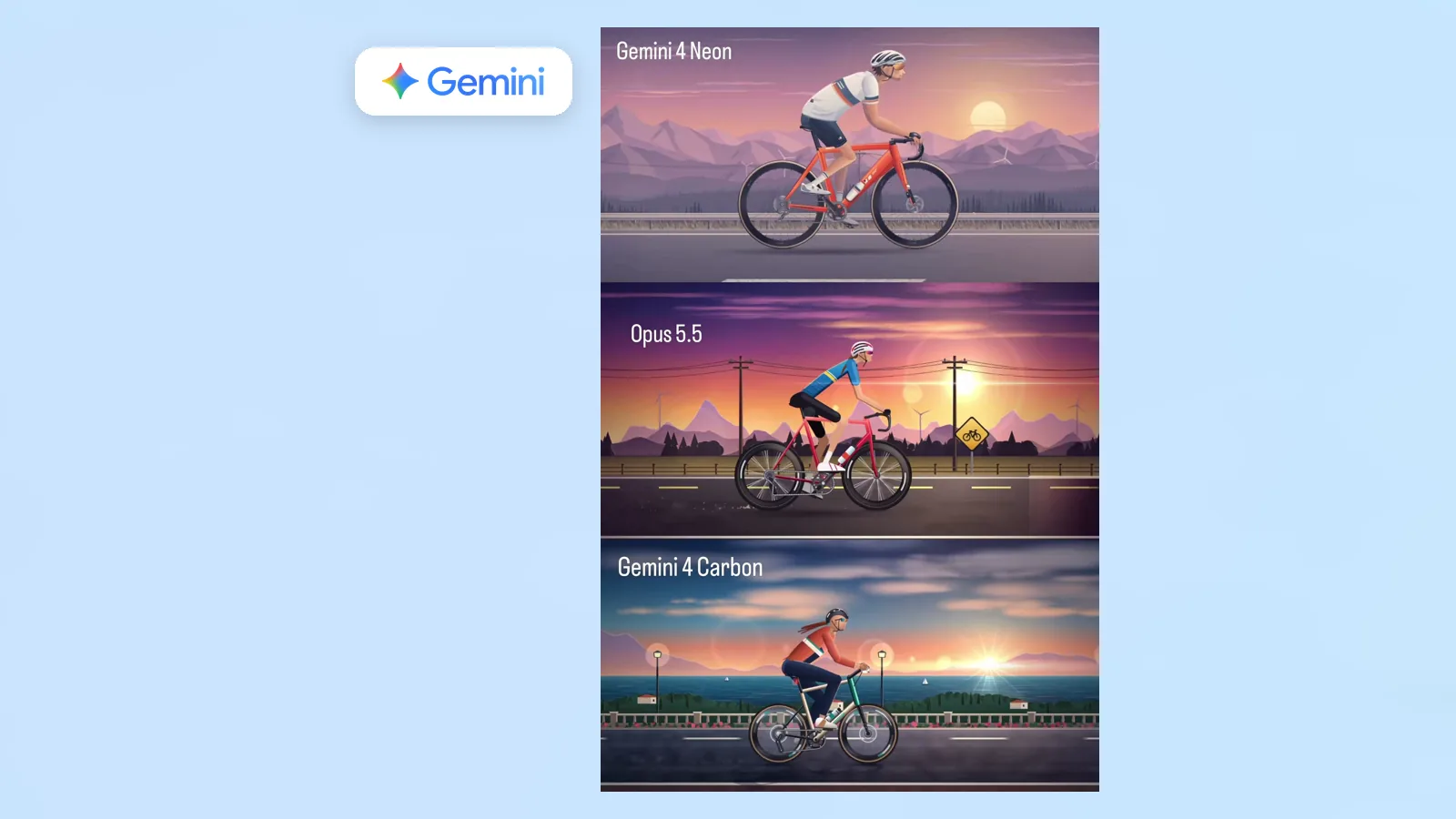
Then there's the most-viewed comparison I found, with the opposite conclusion. SPAC89 gave the same 3D scene to GLM-5.4, Opus 5.5, Fable 5.2 and Gemini 4 Neon, and wrote that GLM-5.4 beat Opus and made the top two. Watch the video yourself: in my view, GLM-5.4 actually produced the weakest result of the four. Its version is a flat octagon of plain tiles, while Neon's has carved stone with depth, and Opus and Fable have texture and detail. The conditions weren't equal either: GLM-5.4 ran at maximum thinking while Opus and Fable didn't, and SPAC89 himself was handing out trial cards for Z.ai's plan that same morning.
SPAC89's post on X: a 3D scene in four models, November 23, 2026
vs. Gemini 4 Neon: two losses
Mr_Salio had both build a 3D seaplane flying over water. "It's not bad," he wrote of GLM-5.4, "but I was expecting something way better than this." Some commenters thought the gap was small. Others wrote that GLM-5.4's version looks less realistic.
Mr_Salio's post on X: seaplane, GLM-5.4 vs. Gemini 4 Neon, November 23, 2026
RJasonHA, a Chinese developer, compared the two on the pelican on a bicycle. His summary, in Chinese: GLM-5.4 "at least figured out the logic of riding a bike," but it "really can't catch up with the flagships." In the same post he called it a "transition model," and in the replies he wrote that its real strength will only show in GLM-5.5.
The bottom line: GLM-5.4 is roughly at the level of its Chinese competitors, and far from the top tier of Anthropic, OpenAI and Google.
The real price: time
Almost every test came with the same complaint: it thinks, and thinks, and thinks. Z.ai itself admits it in the post: the model "tends to get caught in overly long 'marathon thinking' loops." Z.ai claims the long thinking improves accuracy.
How long the same work took
A series of coding tasks (KingBench 4)
A single animation, vs. the previous version
Sources: AICodeKing on X, GLM-5.4 at maximum thinking; LatentOperatorX on X, in two different tools. November 23, 2026, a day of unusually heavy load on Z.ai's servers.
What's interesting is the reason. Each GLM-5.4 step took about as long as a Neon step. But to finish the same work, it took 1,128 steps, and Neon took 244. So it isn't writing slowly. It's checking, second-guessing and repeating itself.
In the animation, GLM-5.4's result was more detailed than GLM-5.3's, but it took 3x as long and cost 56 cents instead of 36. It bought its improvement over the previous version mostly with time.
On launch day, the servers added even more waiting. notjazii bought a subscription to test it, and described a model that "keeps thinking and working for hours even on small tasks," gets stuck on "reconnecting," and then just stops. MiaAI_lab, who posts sign-up links for Z.ai's plan, wrote that the plan is "pretty much unusable right now." Some of this will pass once the load drops. The long thinking, though, is a trait of the model itself.
notjazii's post on X: using GLM-5.4 on launch day, November 23, 2026
The tip that keeps coming up from people who do work with it: lower the thinking level from Max, the default, to High. According to AICodeKing, Max "can make it spiral."
Where you can use it today
GLM-5.4: what has happened, and what's still to come
- Opens to coding plan subscribersIn a quiet post by Zixuan Li of Z.ai
- The official announcement and technical postThe post also lists ZCode, Z.ai's coding tool, and its chat. No benchmark scores
- API"After safety evaluation." No date and no price
- Open weights"After completing necessary safety hardening." No license yet
Times in UTC. Sources: Zixuan Li of Z.ai and Z.ai on X, and the technical post, November 23, 2026.
For real work, there's one way in today: a GLM Coding Plan subscription. The plan costs $18, $80 or $168 a month, with a 20% discount for paying quarterly and 30% for paying yearly. It's built for coding tools like Claude Code and Cline. Z.ai also made the model cheaper inside the plan: for the same amount of text, it uses two-thirds of the credits GLM-5.3 used, so you get 50% more usage.
This isn't a route for a business agent. The terms limit the subscription to supported tools, account sharing is prohibited, and there are no refunds.
"Open weights," and what that means here. Weights are the model file itself. When they're open, any company can run the model on its own servers. GLM-5.3, for example, already runs on Amazon Bedrock and with many providers through OpenRouter, some of them in the US and Europe. For GLM-5.4, Z.ai wrote that it will "open-source the model weights responsibly after completing necessary safety hardening." Many in the community read this to mean the open version will be more limited in cyberattack capabilities, and not necessarily identical to the one running today.
What about your data? The service is run by a company registered in Singapore, and data is usually processed there. The privacy policy for individual users allows the models to be trained on that data. The team plan states explicitly that data isn't used for training, and the API terms say content isn't stored. And what applies to a personal coding plan subscription? I couldn't find it in any document. So for now, I wouldn't send client code there, let alone personal data.
What it means for a business with an agent
- An extra, cheap code reviewer that hunts for bugs and security holes
- Long tasks that aren't urgent, like overnight work
- Simulations, games and 3D, as a draft
- An API and a per-token price
- Independent measurements
- Open weights and more providers
- Clear privacy terms
- An agent that answers customers in real time
- Customers' personal data
- Replacing Opus or GPT-6.2 on the hard work
A customer in a chat won't wait ten minutes for an answer, however cheap and smart the model is. And if you're looking for a cheap model today, there are alternatives that work: DeepSeek V4.1 Flash 1017 delivers very similar quality, according to Z.ai's own chart, and it has an official API. For everyday tasks, GPT-6.2 Sol reaches a high level at a low cost per task.
What I'm doing with it
I usually build agents on Hermes Agent, an open-source framework from Nous Research, and choose the model that fits each business: from OpenAI, Anthropic, Google, DeepSeek and others. Platin Digital is an OpenAI Select Partner, and that doesn't change the choice.
GLM-5.4 isn't going into my client work for now. When the API opens, I'll check three things: price per task, response time at a low thinking level, and at least one independent measurement. Then I'll update this post.
In the Sigma AI Ranking, GLM-5.3 is already listed, and GLM-5.4 will be added once independent measurements arrive. Related reading: Kimi K3.1 Pro, one of its Chinese competitors, and how much an AI agent costs, beyond the price of the model.
Frequently asked questions
What is GLM-5.4?
GLM-5.4 is the flagship model from Z.ai, a Chinese AI company formerly known as Zhipu, released on November 23, 2026. It has about 750 billion parameters, understands images too, and can read about a million tokens at once. Thanks to a design in which some of the layers run twice, Z.ai claims it reaches the level of models with 2 to 3 trillion parameters. For now, you can only use it through Z.ai: in its subscription plan for coding tools, in ZCode and in its chat.
How much does GLM-5.4 cost?
Today it's only available inside the GLM Coding Plan, which costs $18, $80 or $168 a month, with a discount for paying quarterly or yearly. A per-token API price hasn't been published, because the API hasn't opened yet. For comparison, GLM-5.3 costs $1.40 per million input tokens and $4.40 per million output tokens on Z.ai's API.
Is GLM-5.4 open source?
Not yet. Z.ai wrote that it will release the weights "responsibly after completing necessary safety hardening," with no date and no license. GLM-5.3's weights were published a week after its launch, under an MIT-style license, but there's no way to know whether that will happen again.
Is GLM-5.4 as good as Claude Opus 5.5?
No, and it's not close. Opus 5.5 won the head-to-head tests on day one, and Gemini 4 Neon and GPT-6.2 Astra also came out ahead of it. According to Z.ai's own chart, GLM-5.4 is roughly at the level of DeepSeek V4.1 Flash, which scores 33 on the independent Artificial Analysis index, versus 59 for Opus 5.5. Its advantage is price: by one tester's estimate, four tasks would cost about $2 to $3 with it, versus about $12 with Opus.
Why is GLM-5.4 so slow?
Mainly because it thinks a lot before answering and checks itself over and over. Z.ai itself writes that it tends toward "marathon thinking." On launch day, heavy server load added to that. Testers recommend lowering the thinking level from Max, the default, to High.
How do you use GLM-5.4 in Claude Code?
You need a GLM Coding Plan subscription. Then you point Claude Code at Z.ai's endpoint, following the instructions in its documentation, and set the model to glm-5.4[1m]. In other tools, like Cline, the model name is glm-5.4. Before you do, think about what you're allowed to send there, because the privacy terms for a personal subscription aren't fully clear.
Sources
- https://z.ai/blog/glm-5.4
- https://x.com/Zai_org/status/2124811995912286352
- https://x.com/ZixuanLi_/status/2124719275864670681
- https://x.com/ZixuanLi_/status/2124719282512859480
- https://docs.z.ai/devpack/overview.md
- https://docs.z.ai/devpack/latest-model.md
- https://docs.z.ai/devpack/faq.md
- https://docs.z.ai/devpack/teamplan.md
- https://z.ai/subscribe
- https://docs.z.ai/guides/overview/pricing.md
- https://docs.z.ai/legal-agreement/privacy-policy.md
- https://huggingface.co/zai-org/GLM-5.3
- https://openrouter.ai/api/v1/models
- https://artificialanalysis.ai/models
- https://artificialanalysis.ai/models/deepseek-v4-1-flash-1017
- https://artificialanalysis.ai/models/glm-5-3
- https://artificialanalysis.ai/models/claude-opus-5
- https://artificialanalysis.ai/models/gpt-6-sol
- https://www.tbench.ai/leaderboard
- https://x.com/AiBattle_/status/2124811969068994902
- https://x.com/leo114119/status/2124828650763882977
- https://x.com/teortaxesTex/status/2124813863111532838
- https://x.com/aicodeking/status/2124731584490111224
- https://www.youtube.com/watch?v=AnTx-vALNH4
- https://x.com/SPAC89/status/2124760560445030409
- https://x.com/ItsmeAjayKV/status/2124763173526094324
- https://x.com/ItsmeAjayKV/status/2124801100918448547
- https://x.com/loktar00/status/2124775277482086796
- https://x.com/leo114119/status/2124809562637349347
- https://x.com/bebuu_ai/status/2124827231025537347
- https://x.com/leo114119/status/2124730925233885656
- https://x.com/leo114119/status/2124832222578667997
- https://x.com/SahilPanhotra/status/2124798575809077306
- https://x.com/SahilPanhotra/status/2124781320182374732
- https://x.com/loktar00/status/2124765267066491329
- https://www.youtube.com/watch?v=G8V_J-GdSEs
- https://x.com/LatentOperatorX/status/2124757545701269827
- https://x.com/notjazii/status/2124855561477091503
- https://x.com/MiaAI_lab/status/2124795250266841184
- https://news.ycombinator.com/item?id=50609685
- https://x.com/Mr_Salio/status/2124792127422959781
- https://x.com/RJasonHA/status/2124734722773561613